Xuanlin Ye: Translating Dreams
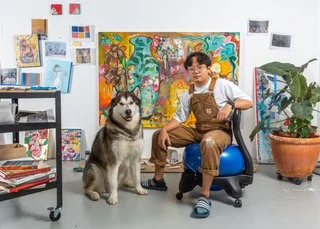
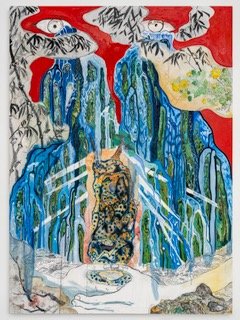
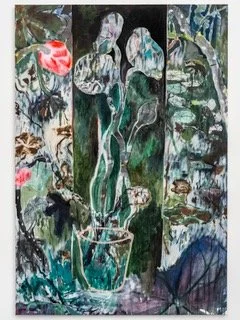
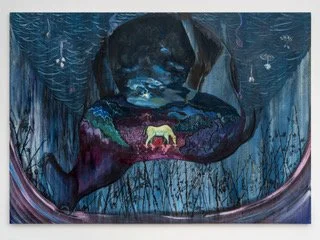
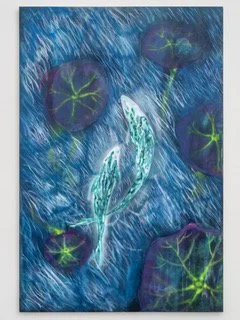
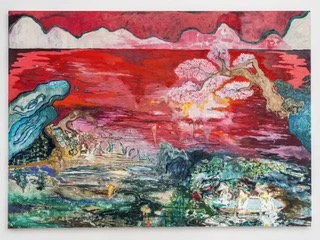
Xuanlin Ye, a Chicago-based artist, holds a BFA from the School of the Art Institute of Chicago (2017), an MFA from Hoffberger School of Painting at Maryland Institute College of Art (2020), and an MA in Art History from the University of Chicago (2022), where he completed his thesis with art historian Wu Hung. Ye’s practice examines how diasporic self intersects with lingering spirituality and overwhelming waves of memories and love. Splashing, cavorting, traversing, and transgressing, Xuanlin Ye’s paintings create a cacophony of colors, textures, and forms. Playfully reimagining the Chinese concepts of time and space, Ye employs photo transferring and cyanotype to imprint the corpus of tomb, mystic tales, cosmic symbols, and ephemeral natures that are simultaneously obscured by his own painterly ambiguity.
How did your creative journey begin?
My creative journey began with a flight from Shanghai to rural Ohio at sixteen. My mother thought it was a good idea, and I went along with it. Back then, as a typical 'gay son' (or perhaps the 'thought daughter' of the family), I was always into writing and journaling. But in the States, I suddenly found my language stripped of its power to communicate. I had to find a new way to speak. I remember the long walk up the stairs to the school art studio; that room became my sanctuary. I spent every afternoon there, translating my dreams and ineffable feelings into images when words simply weren't enough.
In your work, how do you incorporate and reimagine Chinese concepts of time and space?
Honestly, in my recent practice, those grand concepts of time and space have become a bit blurred. For me, it’s really shifted to the intimate space of home-making. I realized I’ve carried this feeling of rootlessness for the longest time, and painting has slowly become my way of anchoring myself, helping me recognize the little, everyday moments that actually make me feel like I belong.
A while ago, My partner and I finished re-watching Bojack Horseman. When the final episode ended, we just sat in silence, embraced, and cried. There's a profound power in resonating with someone completely without saying a word. In that quietness, I realized that was home.
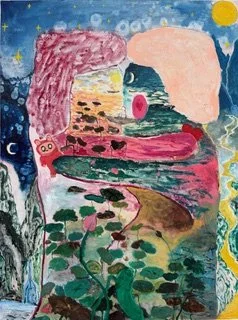
I wanted to memorialize that feeling, so I started looking at Constantin Brancusi’s sculpture The Kiss, where the two forms are so inextricably tied together. I borrowed that intertwined shape to explore how the feeling of 'home' literally grows inside us during an embrace. When I think of my original home, the very first image that comes to mind is a lotus pond. So, in my painting The Embrace with a La Bubu, you see two figures hugging and kissing—with the sun and the moon shining inside their bodies, while a lotus pond shimmers within them.
What does a typical day in the studio look like for you, and how has your art practice grown or changed?
A typical day for me starts around 11 a.m., diving right into painting. As the afternoon rolls in, I’ll bounce between sketching and answering emails. But the biggest change in my practice is how much looser I’m getting. The studio has evolved from just a workspace into a playground for me. It’s a beautiful thing to experience, especially since I've learned the hard way that my work never turns out well if I'm stressed or overthinking it.
Do you see your symbols as fixed in meaning, or are they meant to shift depending on the viewer’s perspective?
I definitely see them as shifting. A symbol's meaning evolves depending on the zeitgeist, the viewer's personal history, and how they connect with the visuals in front of them. That’s the beauty of art, honestly. The forward march of time guarantees that we'll always get fresh and interesting interpretations.
How has social media impacted your work?
Social media mainly just gives me a general anxiety about production—the pressure that I'm not creating enough. It's a frustrating feeling because my priority is always the quality of the work leaving my studio. I need to sit with the details and ensure every painting meets my own strict standards before I let it go. I'm definitely not the most 'online' artist out there. Actually, I actively try to eliminate my social media usage so I can block out the noise and just hear myself think.
What draws you to photo transfer and cyanotype, and how do these techniques conceptually support your themes of memory, trace, and disappearance?
It’s the sheer magic of the process. There’s something fascinating about essentially printing directly onto the canvas, which completely shifts the textural quality of the surface. To get a photo transfer or a cyanotype right, it’s incredibly labor-intensive. You’re physically working the image into the canvas, and you literally have to wash it to reveal what’s there. There's always this element of unpredictability. I love that process because it perfectly mirrors how memory works. Remembering, tracing, and even forgetting—they aren't passive; they all require active work. You have to scrub at it, and you're always surprised by the fragments that actually remain.
How does your diasporic experience shape the emotional and conceptual core of your work?
For me, the diasporic experience boils down to a profound sense of displacement that resonates deeply right now. That underlying instability—the feeling that your sense of belonging is never quite guaranteed—is a shared condition for so many of us. Because of that uncertainty, I fiercely treasure the moments when I actually feel grounded. I intentionally romanticize those glimpses of 'home' in my painting, because those are the exact moments I feel most present, organic, and human.