Gal Cohen: Haunted Shelters
Gal Cohen (b. 1986, Tel Aviv) is a NYC based visual artist, living and working in Washington Heights. Gal works primarily in the painting and drawing fields, incorporating mixed media and printmaking techniques in her 2D works. As an Israeli-American queer artist and peace activist, Cohen’s work reflects the complex tapestry of her identity and an unwavering commitment to justice. Her visual language—fragile landscapes, claustrophobic architectural spaces, and fragmented female forms—reflects the inner dissonance of mothers living through war. Each work serves as a vessel for complexity—an attempt to reconcile grief and grace, despair and resilience.
How did your creative journey begin?
My creative journey began long before I had language for it. As a child, I was constantly drawing—quietly and instinctively, without instruction or external pressure or expectation. I often felt like a misfit within institutional frameworks such as school or after-school programs, but drawing gave me a sense of belonging. It allowed me to be present and to anchor myself through careful observation. Without realizing it, I was teaching myself—training my hand to follow my eye, and my attention to settle on the world in front of me. Through pure observation and without external guidance and language, I learned about light, shadow, negative space, and how mark-making can translate sensory experience onto a two-dimensional surface.
Looking back, I make sense of this early practice as a form of self-soothing and meditation. It created continuity, rhythm, and a sense of presence at the moment. No one assigned it to me; I discovered it on my own and returned to it again and again.
Only later, did I recognize that this instinctive practice was also a strength. As I grew older into my teen years, and others began to notice my ability, I became motivated to deepen my understanding of Painting’s history and legacy. I pursued this education independently, acquainting myself with artists across different periods and movements, studying their work closely and learning from them. At that stage, however, I did not yet pursue a formal academic path in art.
Growing up in Israel, where military service is mandatory for girls at the ages of 18-20, I knew from a young age that I would not follow that path. Instead, while many of my peers were entering the army, I enrolled at Bezalel Academy of Arts and Design. Choosing art at that moment was not only a career decision—it was a life decision- a declaration of values. From very early on, art-making became, for me, a form of resistance to power structures that did not align with my beliefs. It was a way of claiming agency, shaping my own trajectory, and committing to a different kind of service: one rooted in observation, authenticity, imagination of alternative realities and critical reflection.
You speak about motherhood as both resilient and fragile. How does this duality show up visually in your paintings?
Motherhood lives in that constant tension for me — between strength and vulnerability, shelter and exposure. On one hand, it is an act of profound resilience: the daily labor of creating a world that feels seamlessly safe for a child. A space where they can feel seen, protected, and free to simply Be. So much of that strength happens quietly, behind the scenes. At the same time, motherhood reveals how little control we truly have. No matter how carefully I build that shelter, be it physical, emotional, cultural- the outside world still seeps in. That awareness — that love cannot fully prevent harm — is where fragility enters.
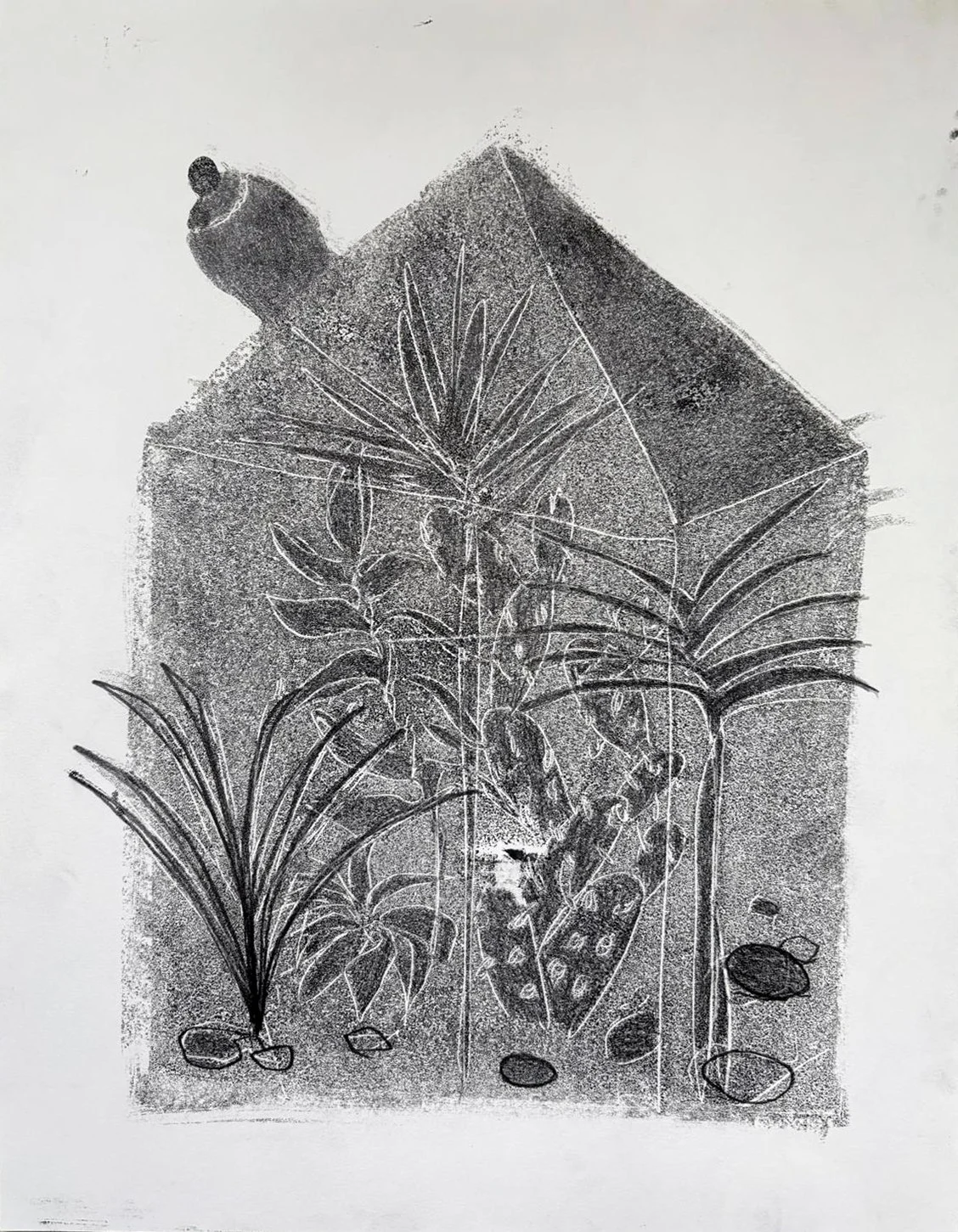
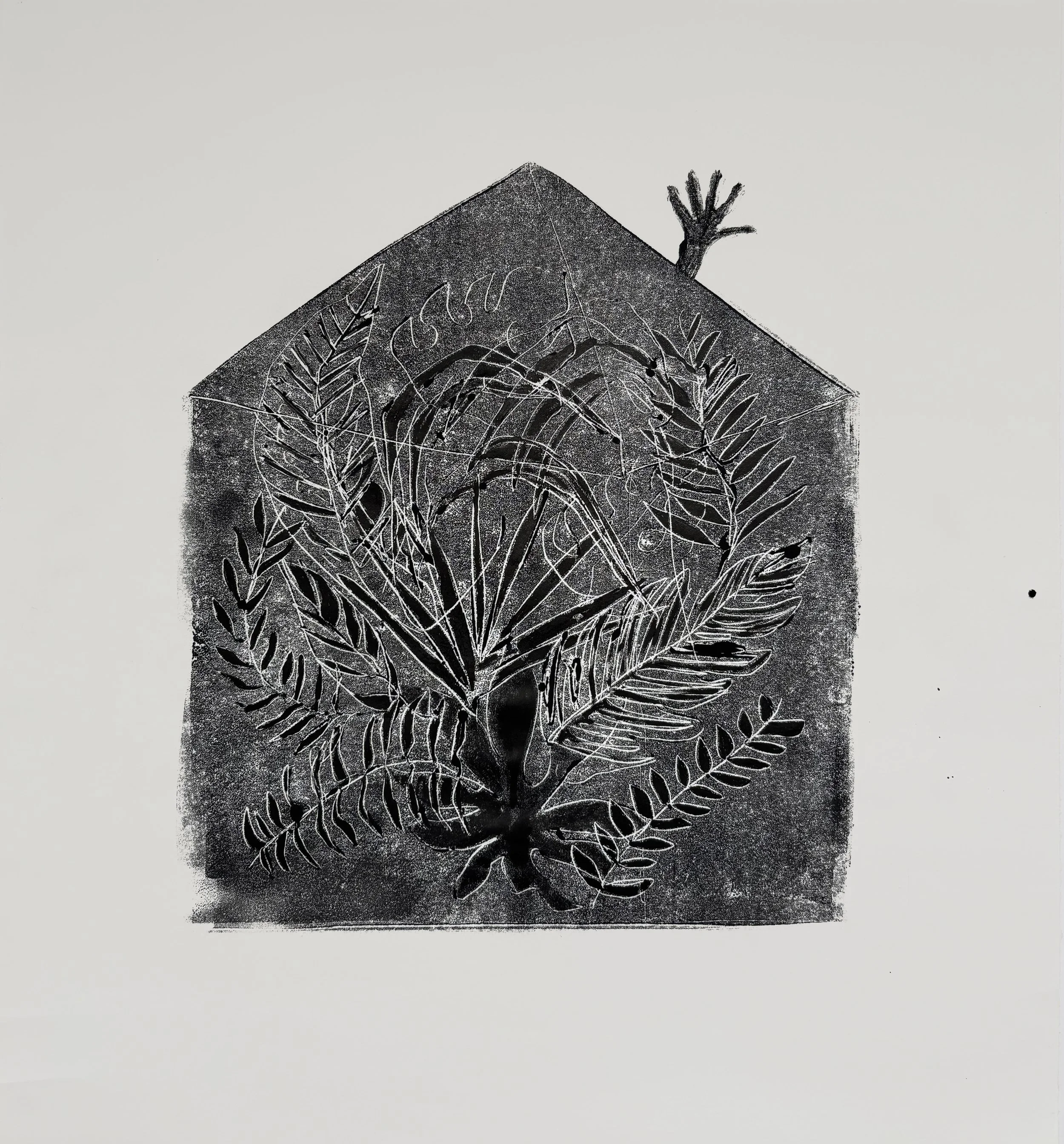
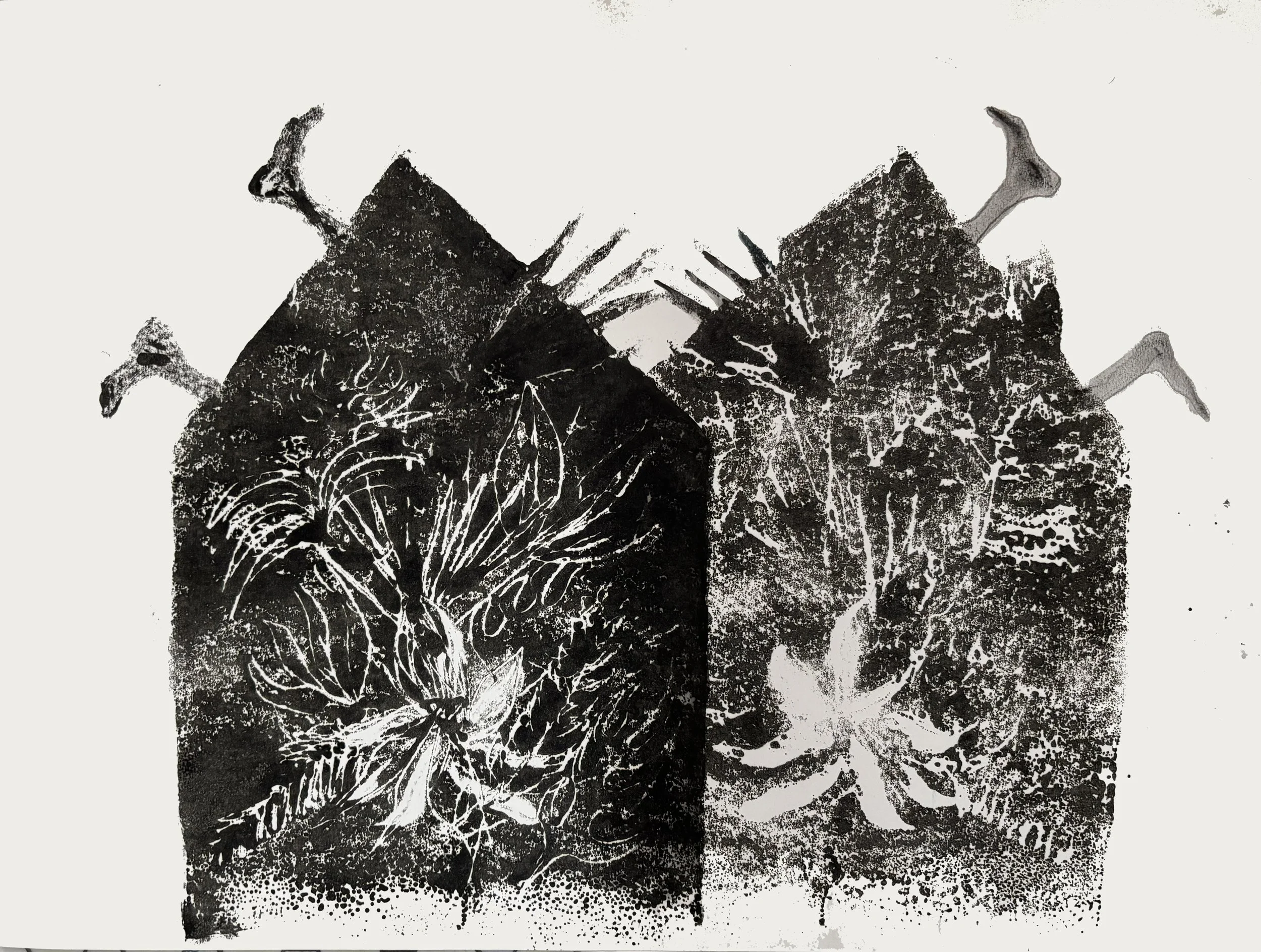
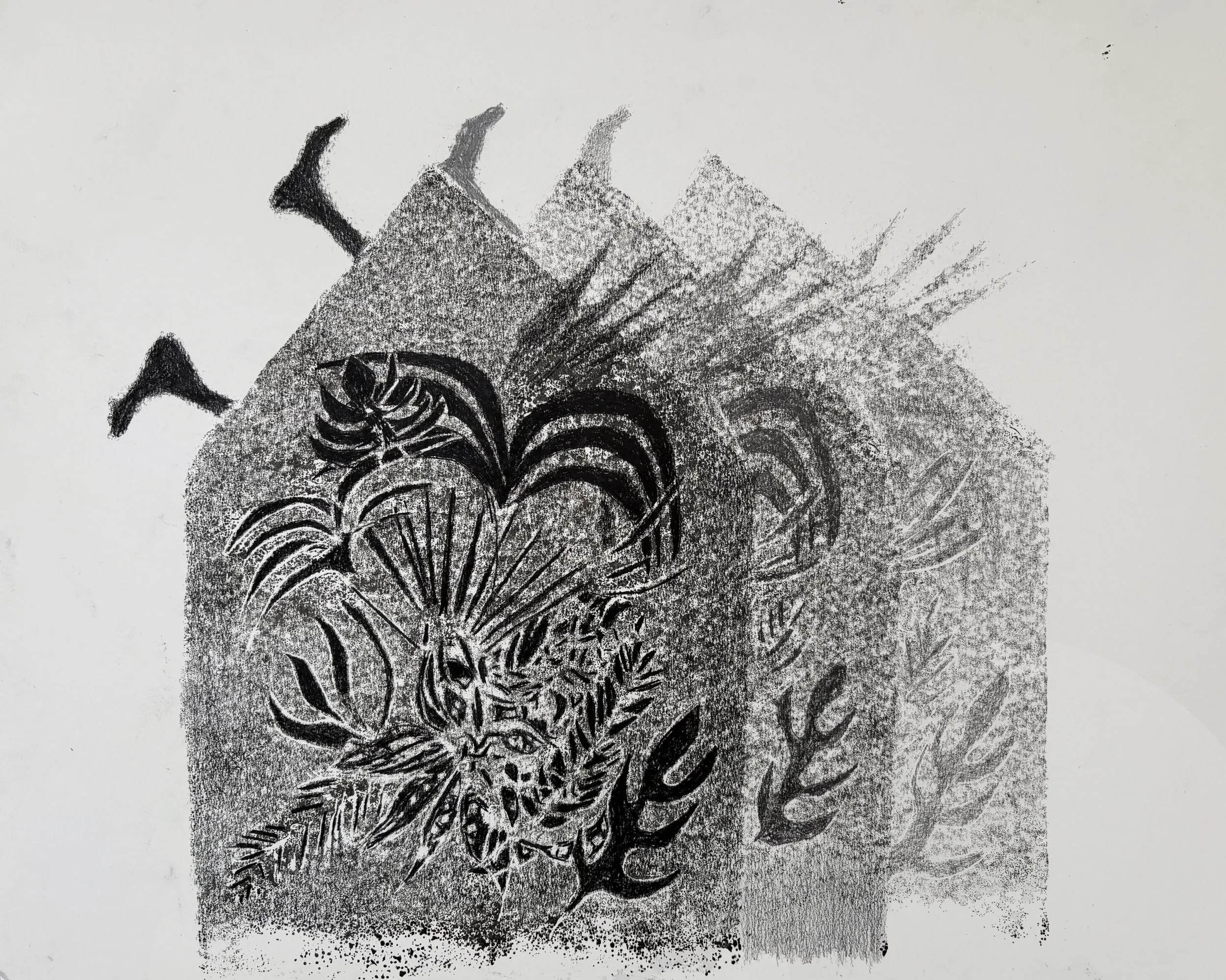
Visually, this duality unfolds through what I think of as “ghost houses” — architectural forms that feel present and absent at once. These symbolic structures are often fragmented or translucent, as if they are memories of homes rather than solid shelters. The house is not full of ghosts, the house Is the ghost.
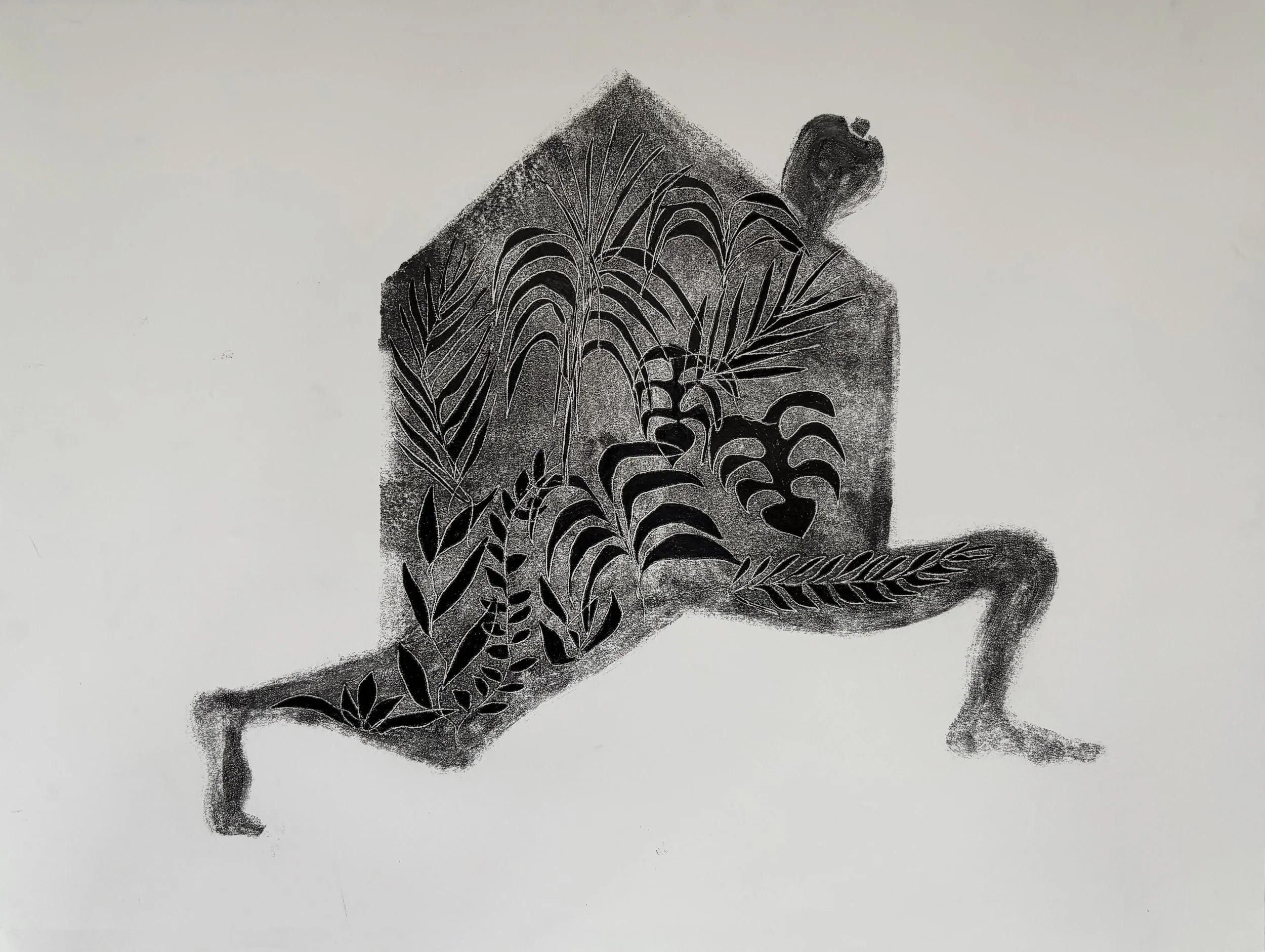
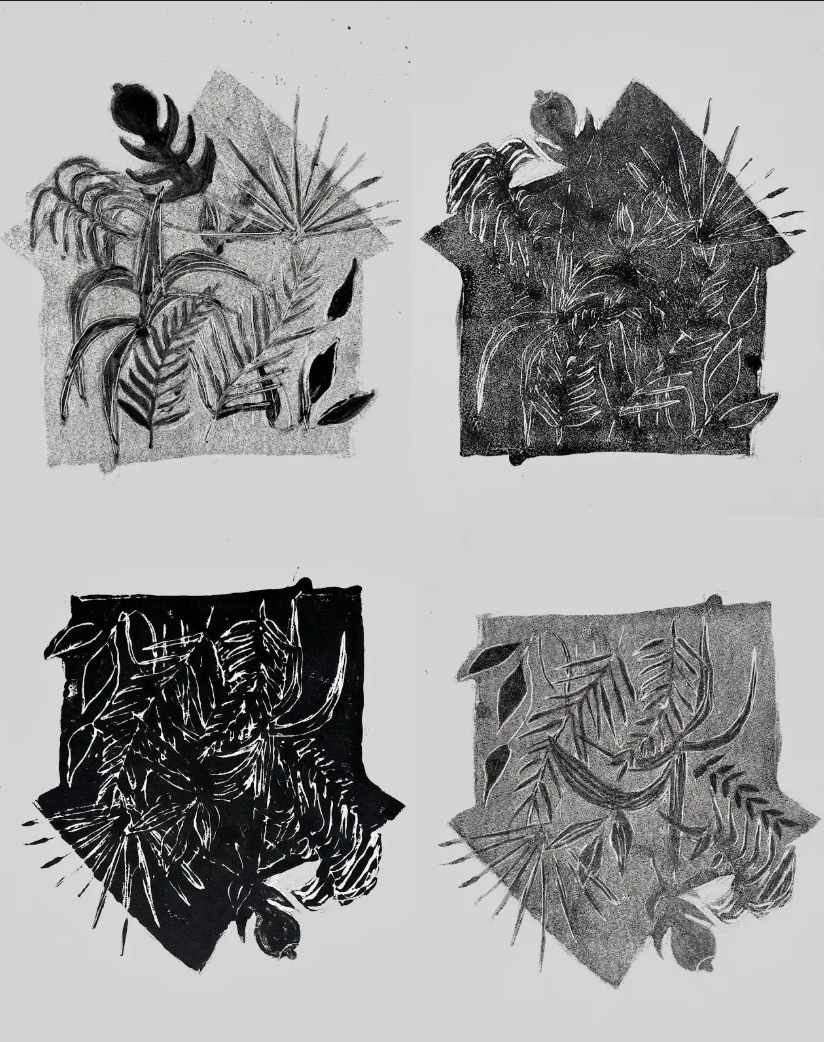
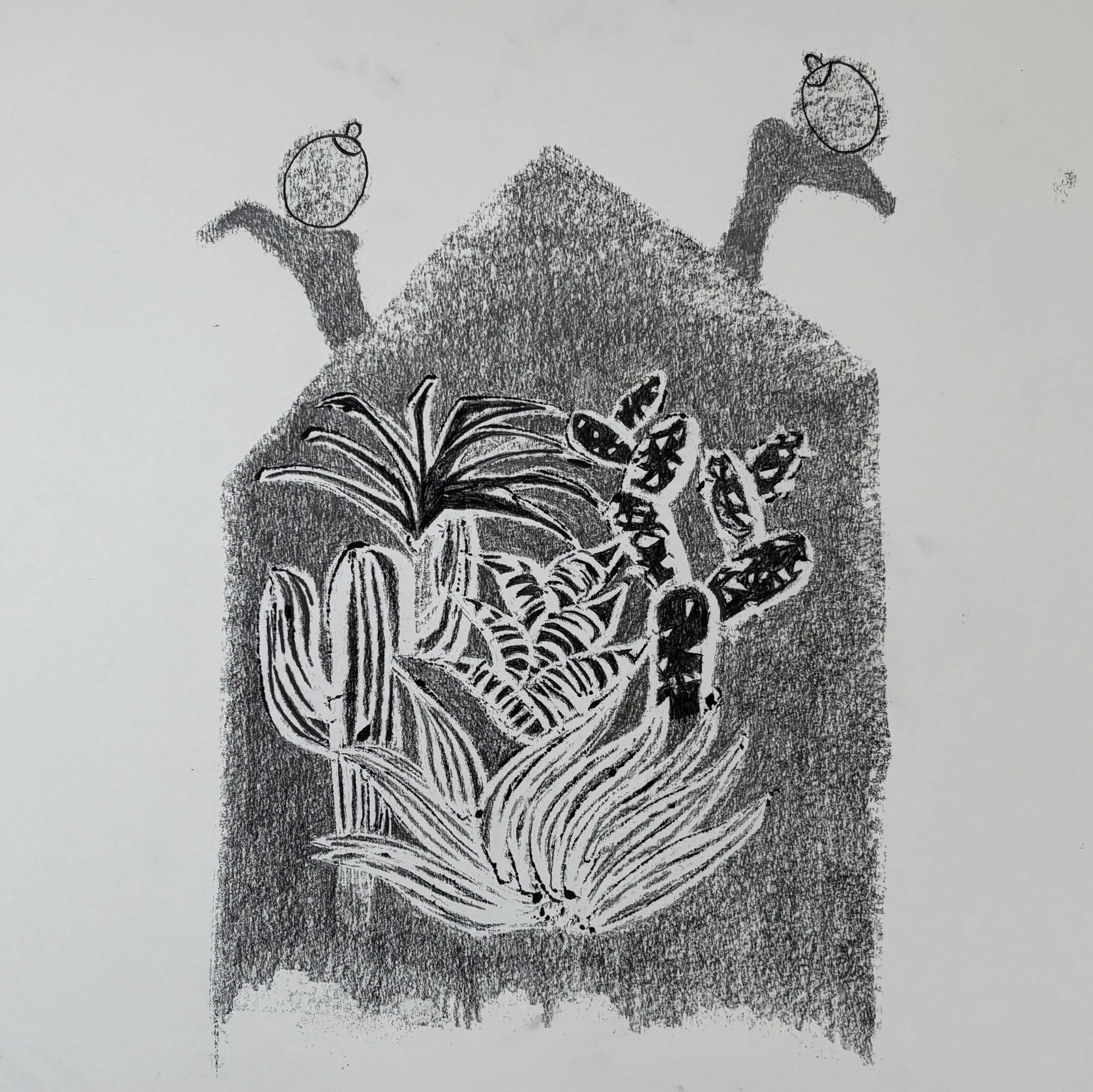
The house form recurs as a central silhouette, but it is never a stable, solid architecture. It is porous, textured, almost dissolving at the edges. It feels less like a solid house and more like a temporary imprint — a ghost of protection. Within these house-forms, vegetation grows densely: palms, cacti, wild leaves. The organic forms suggest vitality, nurture, and persistence, but may also threaten to overtake the structure.
The female body is embedded into the architecture — legs become foundations or points of escape, arms emerge from rooftops as if inviting or rejecting the outside world, boobs become chimneys, or juggling objects. In one work, human legs coming out of a house are stretched wide, straining, trying to quietly escape with the whole house, as if no one will notice, while a boob rising up from the roof top, functions as the head that leads the way. In another, a hand rises up from the rooftop in what may feel like a confident gesture of “Everything’s under control”, or to the exact opposite, as a desperate signal for being buried under physical or emotional rubble, crying for help. The maternal body becomes both the support system and the vulnerable surface. It is the pillar and the crack.
The use of ghost print materiality reinforces this duality. The grainy, imperfect transfer of ink creates an atmosphere of disappearance — as if the image might fade, like memory or like a home erased by warfare. This technique mirrors the psychological state of motherhood in times of upheaval: building safety while knowing that safety is never absolute and hardly under our control.
The house is not depicted as bombed or ruined, but as precarious — hovering between presence and absence. These are haunted shelters. They carry the echo of homes that once stood firmly and may no longer exist, whether through warfare, migration, or emotional rupture. The fragility lies in that awareness: that no matter how fiercely a mother protects, she cannot control the forces outside the walls. And yet, there is resilience. The figures do not collapse. The vegetation continues to grow. The structures, though ghostly, remain upright. Motherhood here is an act of continuous holding — a balancing of weight, memory, and fear — creating shelter even when the ground feels uncertain.
What does a typical day in the studio look like for you, and how has your art practice grown or changed?
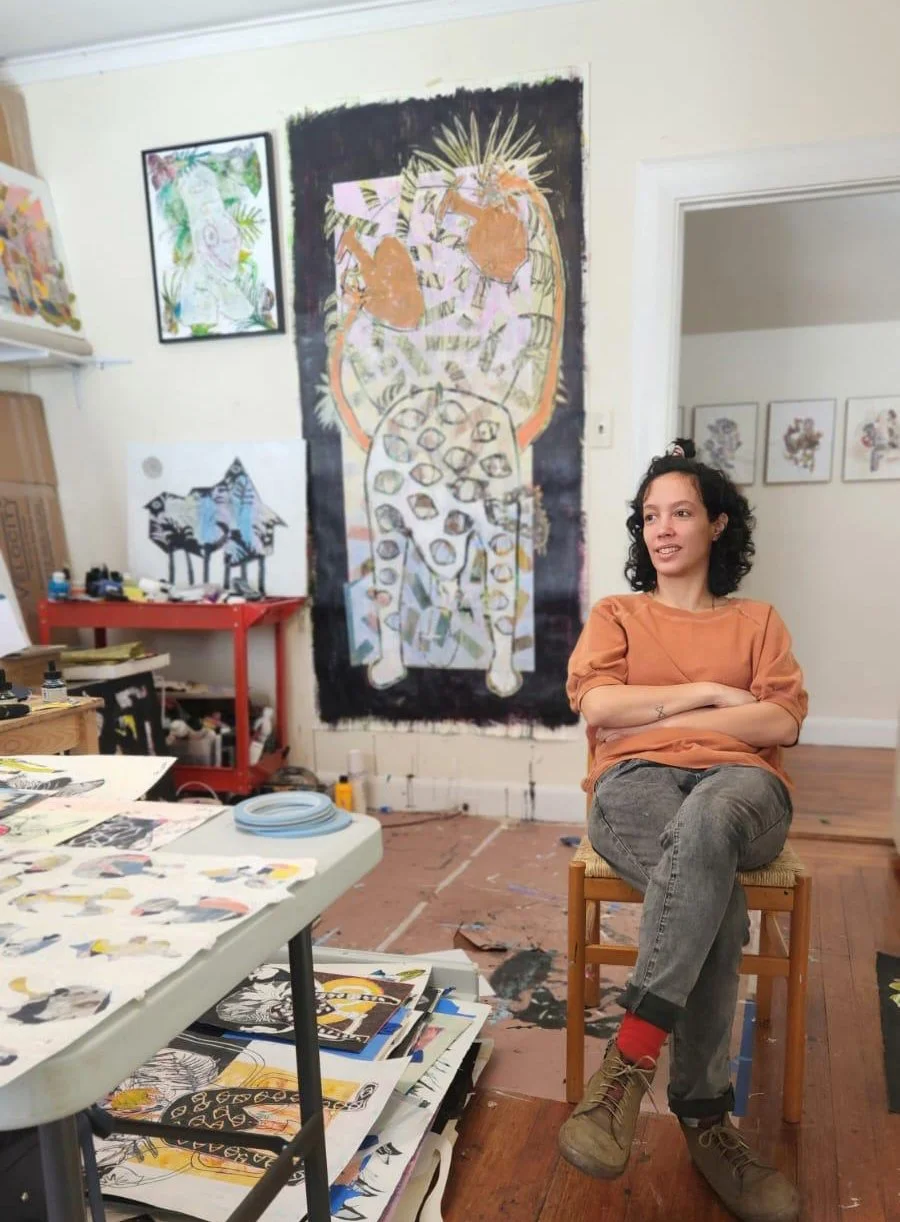
A typical day in the studio is an organic balance between structure and creative flow, in a non-linear way. I don’t usually work on a single piece from start to finish. I work in bodies of work, and often on several pieces simultaneously. There is almost never just one work in progress. I might begin the day with one print or drawing, building a layer, then step away while the ink sets or the surface dries, and shift to another work. Sometimes I leave a piece not because it’s finished, but because it needs distance. Moving to another piece allows me to return with different eyes. The studio becomes a space of circulation — of materials, ideas, and emotional states — rather than a single fixed focus.
Over time, my practice has grown to trust this rhythm. Earlier in my career, I felt pressure to resolve things quickly, to complete one work before beginning another. Now I understand that the dialogue between works is part of the process. They inform one another. Forms migrate from one piece to the next; an architectural shape in one drawing might reappear as a bodily gesture in another. The growth in my practice has been less about changing subject matter and more about deepening — allowing themes of home, body, and fragility to unfold across multiple surfaces, layers, and iterations.
The studio, for me, is not only a place of production. It is a place of presence — where images slowly accumulate, echo, and evolve over time. I often create while listening to the radio or a podcast. The sounds and ideas drift into the studio, influencing the rhythm of my thinking and helping language take shape. Yet I stay attuned to alignment; When the energy no longer serves the work, I let it go.
How does your commitment to anti-occupation activism shape not only your subject matter, but your artistic decisions and materials?
My anti-occupation activism and my art practice are not parallel tracks — they are intertwined currents. Each informs the other in an ongoing exchange. Activism sharpens my sense of responsibility and accountability; it confronts me with urgency, grief, and moral commitment. The studio becomes a place where I metabolize the harsh realities that my Activism tries to confront and resist. In the studio I can slow down, process and reflect on these realities, and make work that is derived from it.
For the past two years, I have been waking up in my physically safe home in New York to news from Israel–Palestine: images of houses reduced to rubble, families buried beneath them, and people searching for missing loved ones. Alongside witnessing, I have been actively engaged in anti-occupation organizing and protest — standing publicly against policies carried out in my name, demanding accountability, and aligning myself with grassroots movements that call for justice, equality and safety for Palestinians and Israelis alike.
I find myself constantly thinking about the mothers there — in Palestine and in Israel — putting their children to sleep without knowing where or when the next bomb might land. That unbearable fragility of shelter stays with me. So does the survival guilt of being safe far away, the fear for my loved ones, and the shame and grief over what my country’s army and government are doing. These emotions do not remain abstract; They enter the studio with me.
But my goal is not to illustrate these events directly. Instead, I try to work from within these emotional and political terrains. Questions of power, vulnerability, responsibility, and the limits of protection enter the work structurally; through fading transfers, unstable architectures, fragmented female forms, and houses that appear both protective and incapable. The ghost print itself becomes essential: each repetition grows lighter, more fragile, as if the image is both present and disappearing. Homes become bodies; bodies become shelters; shelters are precarious. The instability of the surface echoes the instability of safety.
Activism, for me, insists on accountability and shared humanity — for Palestinians and Israelis alike. In the studio, that translates into refusing simplification. I allow grief, tenderness, anger, and ambiguity to coexist. I work through metaphor, leaving space for interpretation, so viewers can enter through feeling, rather than through the calculus of who is right and who is wrong. I hope the work reaches the mother-heart in all of us — beyond binaries — toward a space where fragility is recognized without being weaponized.. My art does not illustrate my politics — it carries the emotional and ethical weight from which those politics emerge.
How has social media impacted your work?
I have very mixed feelings about social media. On one hand, I struggle deeply with it — with the binary thinking, the speed of judgment, the abstraction of real human lives into headlines and slogans. Especially in the context of Israel–Palestine, I’ve felt how quickly nuance disappears and how easily grief becomes weaponized or flattened. There is so much noise and aggression, and often very little space for holding multiple truths simultaneously.
And yet — I’m on it. I receive updates, news, testimonies, images. It keeps me connected across distance. As someone living in New York while deeply tied to what is happening back home, social media has become an immediate, unfiltered stream of reality. It’s overwhelming, but it’s also connective.
I’m very aware that the algorithm shapes what we see, amplifies outrage, and rewards certainty over doubt. That awareness has actually influenced my work. In contrast to the speed and absolutism of social media, my studio practice insists on slowness, ambiguity, and material presence. Where social media flattens, I try to layer. Where it polarizes, I try to hold contradiction. Where it demands clarity, I allow uncertainty.
So perhaps the impact is this: If social media intensifies emotion and promotes binary thought, my art moves in the opposite direction. It becomes a counter-space — where simplification is resisted, and the fragile human scale behind the screen is reclaimed.
Does your queer identity inform the way you depict bodies, intimacy, and emotional vulnerability?
As a gay woman in a same-sex marriage raising two children, I inhabit motherhood outside heteronormative structures. That positionality matters. It shapes how I understand embodiment, care, and power. To mother, as I experience it, is to practice radical care in a violent world. It is to insist on interdependence within a culture that valorizes dominance. It is about claiming softness without romanticising it.
My insistence on motherhood — rather than the more neutral “parenthood” — is deliberate. It is through this lens that I examine shelter, survival, and care. Queerness is not aestheticized in my work; it is embedded in the ethics of how and why I build these images.
In my visual language, this translates into bodies that become shelters — houses that are at once protective and unstable. The maternal form is not idealized; it is architectural, burdened, porous. I am drawn to the politics of vulnerability — to the tension between precarity and resilience. The ghost-houses and hybrid 'body-homes' suggest that home is not a fixed site of stability, but a fragile construction sustained through ongoing labor.
How do you hope audiences from different cultural or political backgrounds will engage with your work?
First and foremost, my work is visual. It seeks to capture the viewer, draw them into a space where thought, feeling, and reflection can unfold. I invite sitting with vulnerability and ambiguity — traces of a shared humanity that exist before ideology. I hope the work sparks responses not from bias or the divisions of identity politics, but from recognition: of our own pain, our own guilt, and the ways we may cause suffering in the world. I want to remind viewers that the mother — who brings life, nurtures, fears, and grieves — exists on all sides of conflict.
I hope the engagement of viewers from different backgrounds with my work will be the exact opposite of social media. Instead of amplifying unproductive, polarizing emotions, my visual language — ghostly, symbolic, whimsical — invites viewers to explore the deeper “what” of experience. It encourages openness, reflection, and curiosity, rather than trying to win an argument or make a statement.
While our histories shape how we see, the images offer a human entry point — shelter, fragility, protection — from which meaning can unfold uniquely for each person. More than agreement, I hope for recognition: a moment in which viewers see their own fear, vulnerability, and resilience mirrored back to them — and begin to recognize those same human currents in those they stand apart from, all held within one shared emotional landscape.