Jocelyn Fine: Sacred Places
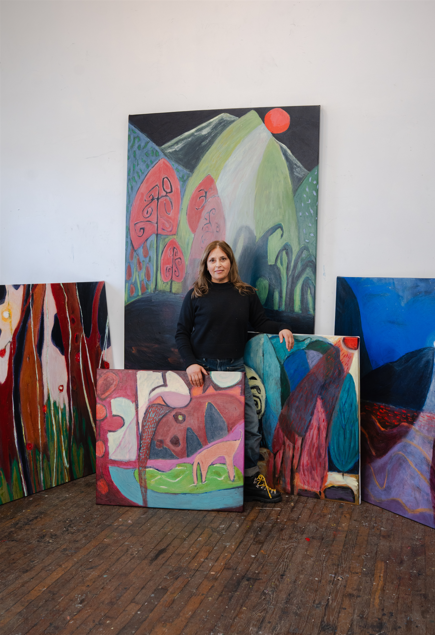
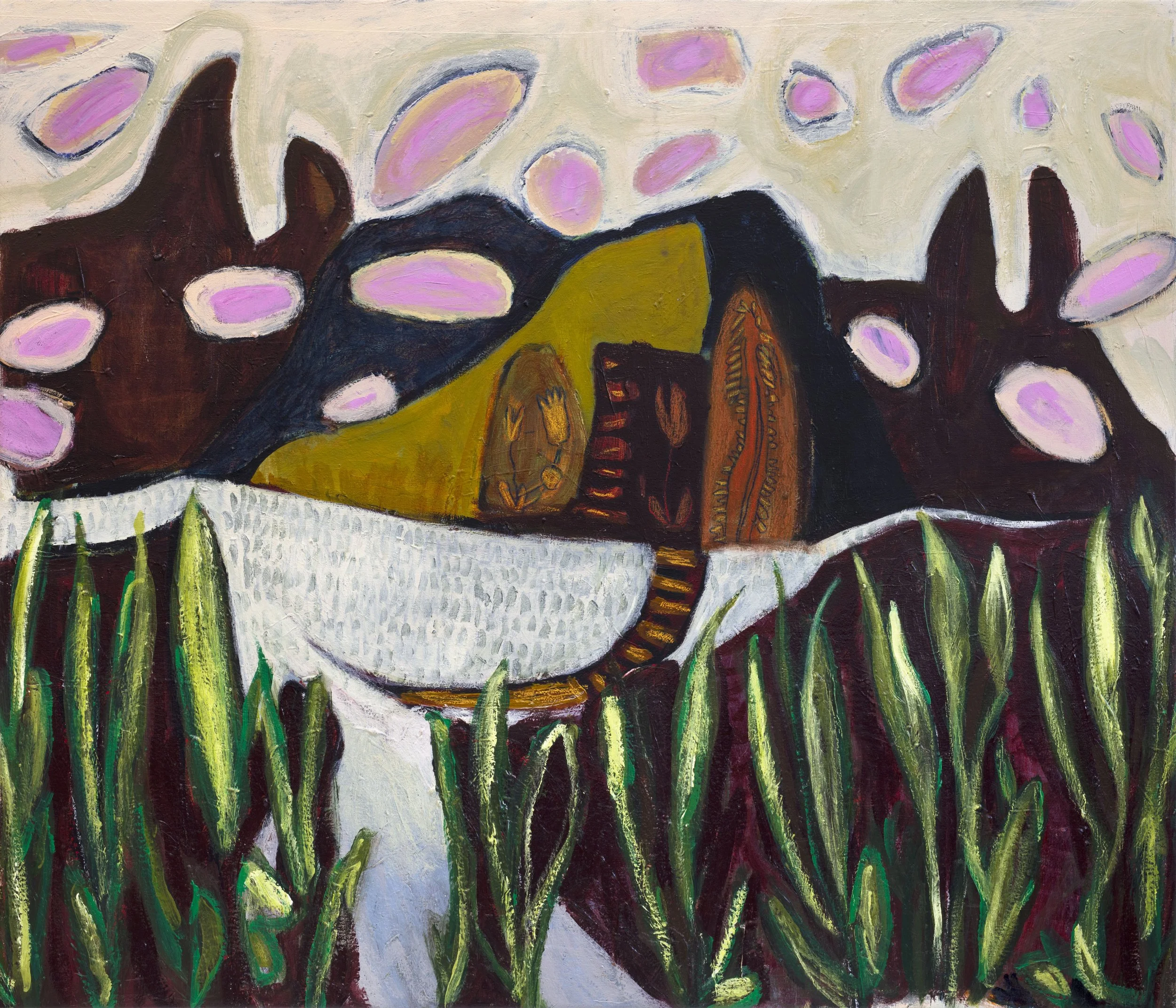
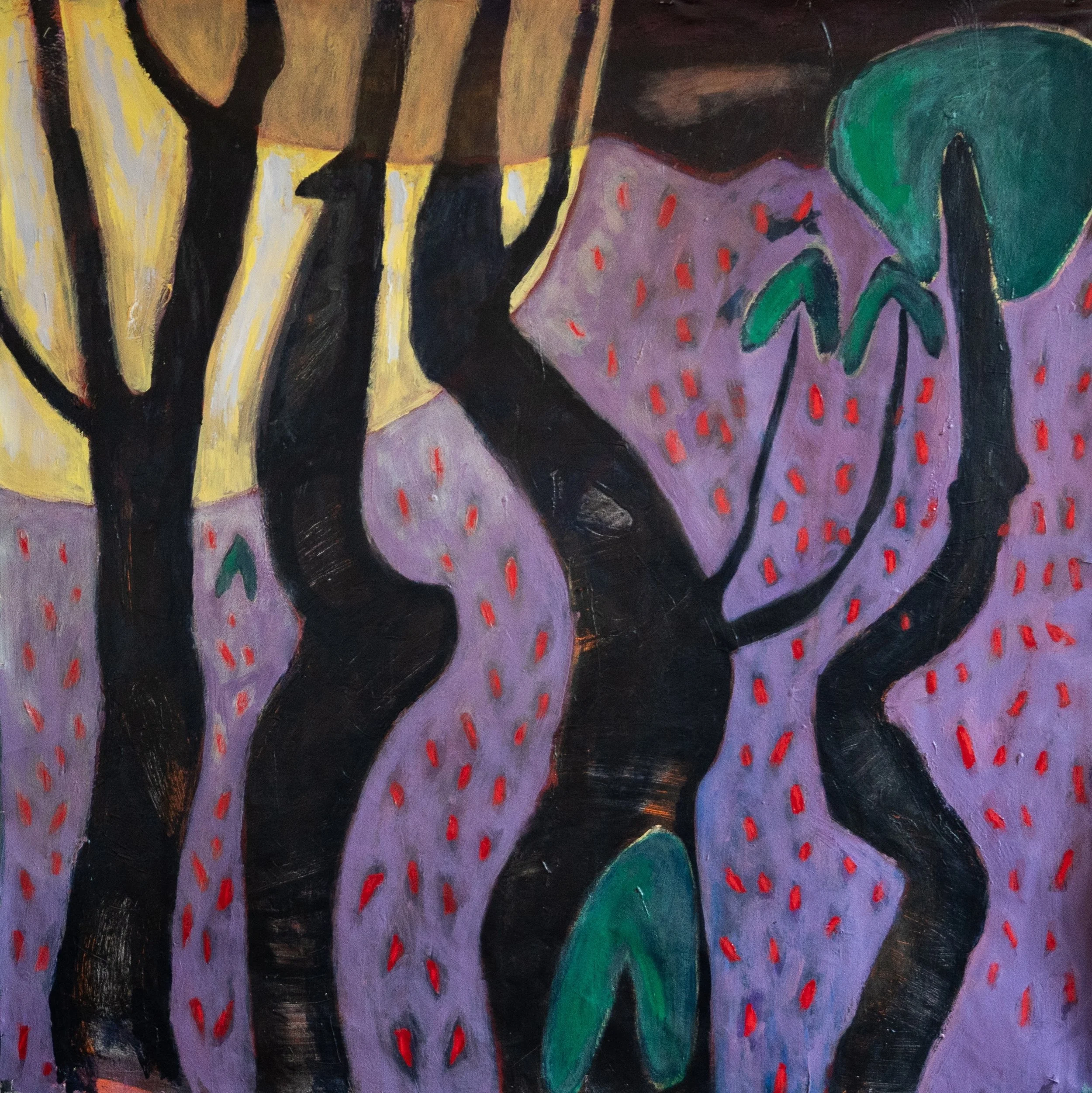
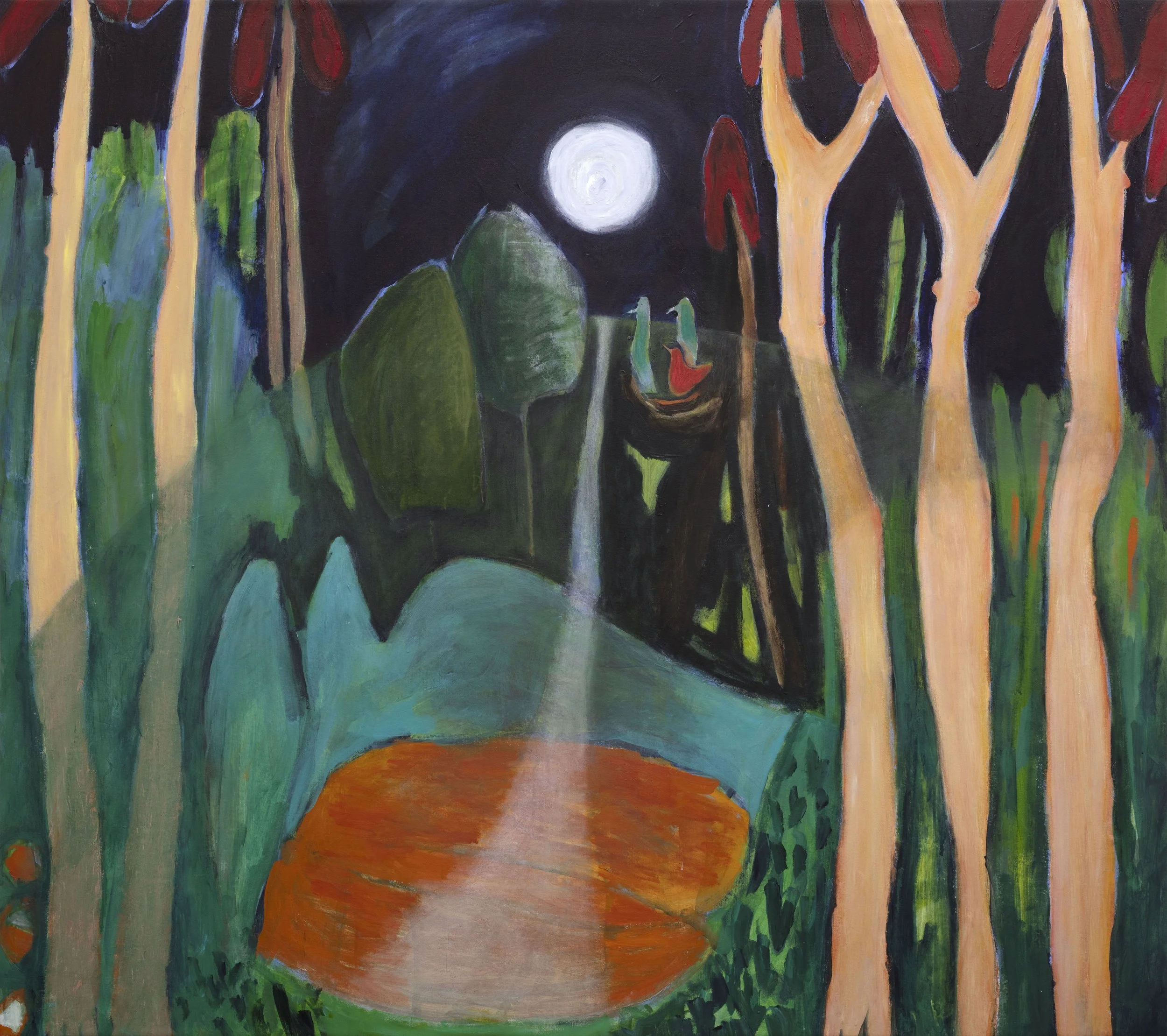
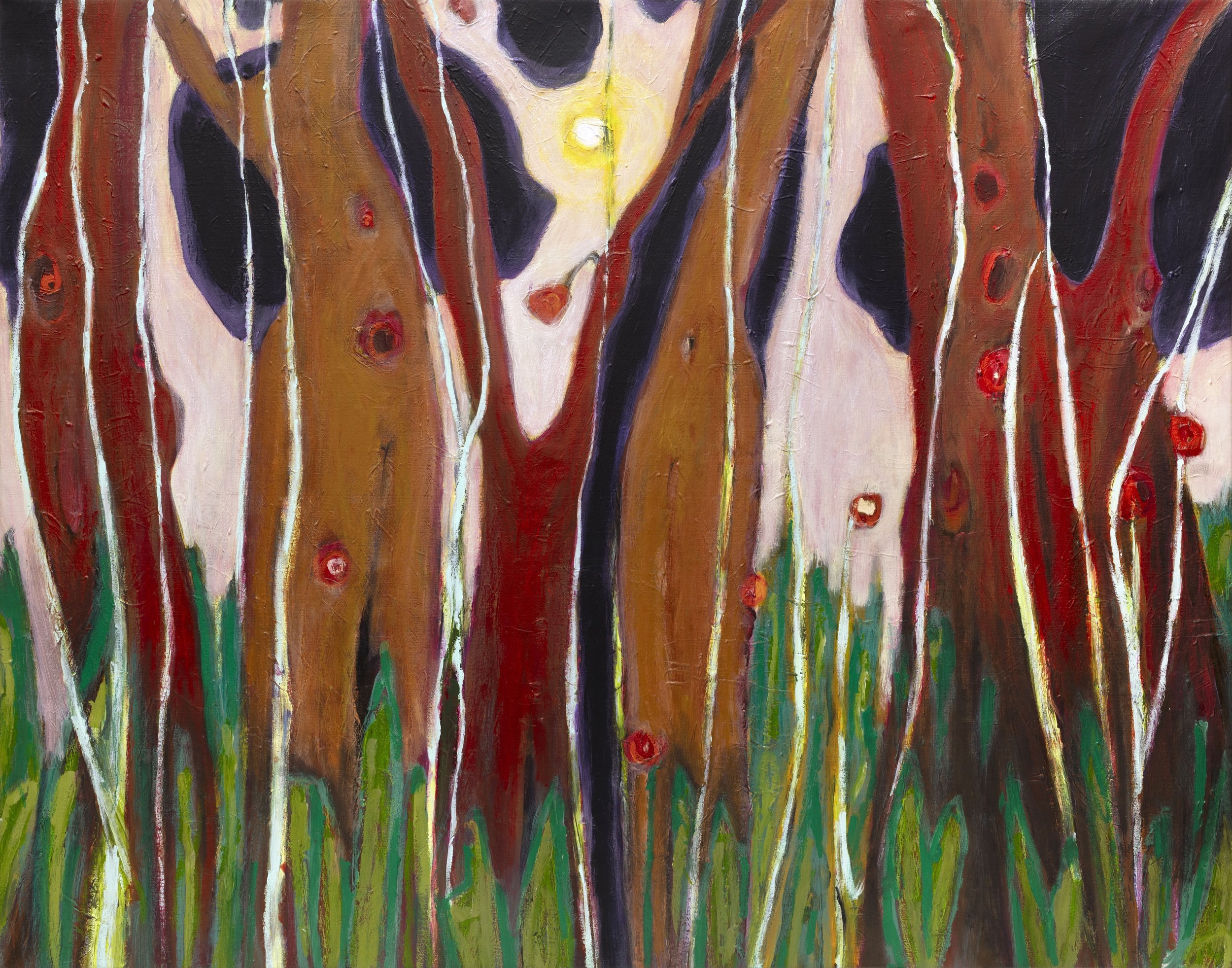
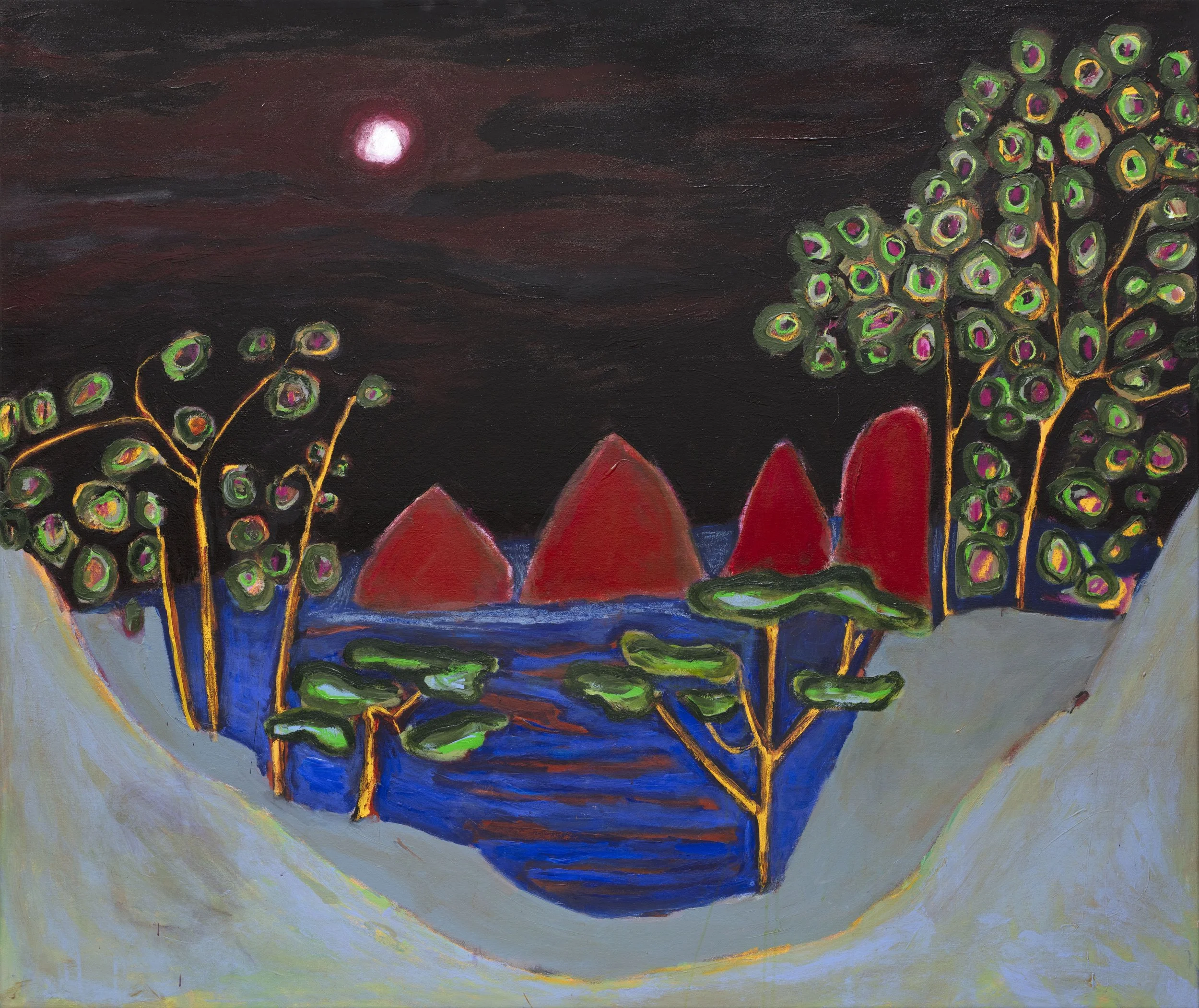
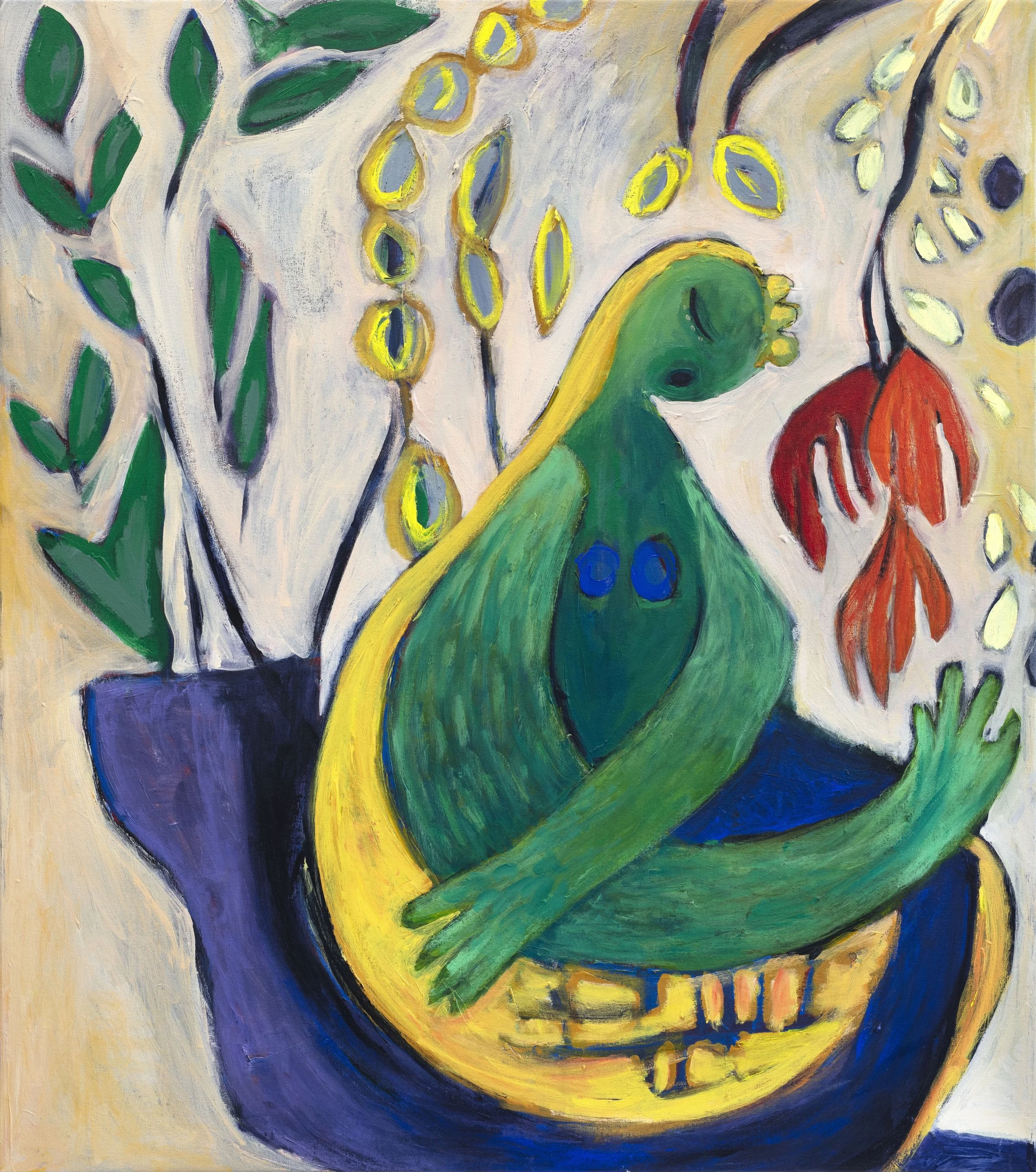
Jocelyn Fine (b. 1969, Pittsburgh, PA) currently resides and works in New Jersey. Her work stages a convergence between the natural world and the human body. It works from the belief that the energies, or life forces, that animate nature are the same ones that animate mankind. Her paintings take shape through energy and movement, to the point where they appear invested with the energy and movement that was required to create them. They portray the essence, or pulse, of the natural landscape and play with anthropomorphism, grafting natural elements and shapes onto human (or human-like) forms, like trees emoting, landmasses pictured in conversation with the stars and moon, or tree bark that might be mistaken for human skin. By showing us what nature has in common with us, these images likewise have the power to show us what we have in common with nature, sparking a process of mutual understanding, empathy, and, ultimately, respect.
How did your creative journey begin?
I grew up in a family of artists and image-makers. Art was around me all the time. My mother, now in her 80s, is a sculptor who began her career carving stone. My great aunt Rose ran the eponymous Rose Fried Gallery in NYC from the 1930s to 1970, and introduced artists like Mondrian, Arp, Klee, Léger, Kandinsky, Balla, Ernst, and Duchamp, giving Alice Neel, Kurt Schwitters, Sonia Delaunay, and Torres-García their first solo New York exhibitions. Not surprisingly, all three of my siblings are also artists working in arts-related fields, and both of my children are working artists too. Art was how we understood ourselves and communicated with one another. We were introduced to the visual world through travel. My childhood summers were spent crisscrossing the U.S., Canada, and Western Europe in a converted Chevy van; this was back when we didn't have cell phones and as a young child I didn't take many photographs. I had a big imagination, and the visual world fascinated me. When I wasn’t traveling, I was playing make-believe in my room, building dollhouses, making characters, constructing alternate realities out of whatever I could find. Solitude was not a punishment. It was where I felt most myself, where fantasy and imagination became a portal; a place I could slip into and disappear. My work is really about distilling those childhood memories and expressing them through my body. I approach each canvas with the child-like curiosity of experiencing something for the first time, that sense of the unknown.
How does nature inspire and influence your artistic practice?
I'm drawn to this question of where the body ends and nature begins. Trees morph into human silhouettes. Rock formations breathe. Scale just collapses. The boundary between the natural world and the interior world dissolves, and that dissolution is really what I'm after. My landscapes are places that feel both known and foreign at the same time. You might look at one of my paintings and recognize a lake, a bird, trees, branches against a darkening sky, but the dimensions, the colors, the forms, they're meant to take you somewhere else. Worlds I may have visited in memory, or ones I imagine entering, somewhere mystical, optimistic, very personal.
The natural world was always what inspired me. I remember visiting my grandmother in upstate New York as a young child. My brothers, sister and I would go on our own mini explorations and they always evoked a feeling of magic. I have one memory of walking through the creek across the road from her house. The water was frozen solid. The sky was this light blue, everything crisp white, blue, grey, and the leafless trees had icicles hanging off them like crystals. We had this feeling like we weren't supposed to be there, which of course made it more thrilling. We walked the frozen creek, jumping stones, skating a little across the ice, collecting icicles as long as my arm, glistening in the sun. I've never forgotten that feeling of awe; that magic was just available, all around me, if I was willing to notice it. That memory, and others like it, are what I'm still trying to paint, honestly.
My memories aren't linear, they're not fully formed, they come to me as impressions, textures, and the emotional residue of a certain quality of light. I search for them the way I search through old photographs, or childhood journals. Not to reconstruct the past, but to re-enter it. To get back a feeling I can't access any other way.
What I'm searching for, in the studio, on the canvas, is a world that coexists within this one. Present always, but rarely permeable. These aren't imagined places; they're somewhere I've already been. In the body, in sleep, in the particular quality of light on a hillside going dark. I want to be fully inside them; to feel the moss, the dark air, the weight of whatever's living in the branches. To be dissolved into it. Not observing nature from the outside, but becoming indistinguishable from it.
What does a typical day in the studio look like for you, and how has your art practice grown or changed?
I usually start by meditating, just getting myself connected to the space. Especially during the school year, when I'm coming from a full day of teaching meditation and breath work helps ground me, connects me to the space. My studio is a very sacred place for me.
When I start, I never really have a specific idea. I begin with a large unstretched canvas tacked directly to the wall-it feels almost like a fresco in that way, just a hard substrate, and I make marks with charcoal on the surface. It becomes like a dance, very gestural. I'm always listening to music, and the composition of forms starts to emerge. It feels a bit like construction, building blocks one after another, laying out a foundation of shapes that are really just placeholders. I work physically, intuitively, moving between multiple canvases, letting my body lead, surrendering to the material. I see blocks of color, building blocks set in place, ready to be reconfigured.
Once those shapes exist, I come back in with colors I know will never be the final colors-they're oversaturated, a lot of vibration, energetically very strong. The idea is to build up the surface slowly, color on top of color. That's when the composition starts to reveal itself. Strangely, a lot of what I originally intended gets covered up, but many of the elements are still there underneath. The moonbeam, the fish, the transparency of the water, things like that just arrive as I'm constructing the piece. All of my paintings are landscapes, but they're landscapes that feel human. There are rarely people in them, but there's this sensation of a human presence-a soul, a pulse, some sensation of a life. Natural elements embedded with consciousness.
In 2014, I was in my early 40s, teaching, with two young kids, busy doing the million things we all do, and I was diagnosed with breast cancer. It was one of those moments where your whole life pauses unexpectedly, where you go from running at 150 miles an hour to completely stopping. I had surgeries, chemotherapy, and it forced me to pause in a way I hadn't in years. It taught me about my own fragility, the fact that we're only here for however long we're here, but it also made me realize that the beauty of the natural world exists around us all the time, and I simply hadn't had the time to stop and look at it.
I remember sitting on my front porch, just looking at the green trees, noticing shades of green, the way the breeze hit the leaves and the way the leaves responded. Things I felt like I'd never really noticed before. That was a pivotal moment for me as an artist. That's when I started to understand this idea of wanting to capture what it feels like to see the world for the first time. Before that, my work was pretty abstract, I don't know that I even had a voice yet.
It's evolved a lot since then, but there's still this longing and searching, trying to understand where I fit in the world, trying to reconcile the enormity of the natural world; the fact that it existed before me and will exist after me. There's actually comfort in that. Knowing the pulse of nature will survive the passage of time, that it exists outside of human existence.
I think what that period did was bring me back to that place of seeing the world for the first time; that liminal space between the subconscious and the conscious, what it feels like to be awestruck by a sunset, or a moonbeam. If you spend enough time with children--which I do, since I teach young children art --you remember that everything is exciting to them. And as a child, I was always drawn to fairy tales, to the fantastical. So this period pulled me right back into that. A lot of my work does feel like it's from a fairy tale. My landscapes feel like sacred places; maybe places you've been before, maybe places that only exist in your imagination. Nature has its own colors, and I give it more, bigger, wilder, I never lose that instinct to expand.
How has social media impacted your work?
Social media has been instrumental. Not only have I seen art from remote corners of the world that I would never otherwise have had access to, it's also given me a way to share my own work with a much broader audience. I've made real friendships through Instagram with other artists, people I might never have crossed paths with otherwise, whose work I now watch grow the same way they watch mine. And more than once, a gallery has found me there, reached out cold, and it's led to an actual show. It's an incredible tool for artists, it really has the capacity to make introductions, to connect you with people and artists who share your interests, in a way that just wasn't possible before.
How does your work visualize convergence between the natural world and the human body?
I see trees as a way to explore the complexity of my humanity, specifically the areas of disfigurement, resilience, and acceptance.
I'm fascinated by the relationships that exist within tree communities: how they commune with one another, take care of one another, transfer energy, share resources. And maybe most importantly, they don't judge. An aged, twisted, contorted tree is celebrated for its resilience. Its bark is a barrier of protection, an entire ecosystem of adaptation.
The knots and bark of a tree remind me of my own skin, which changed permanently after chemotherapy. For a long time, it was something I struggled to make peace with. And yet I'm learning from the trees that it's also my greatest protector, it holds me tight like a blanket, acts as my barrier against harm. It's discolored, mismatched, always on alert, always ready to respond to a threat. It's the first organ in my body that knows when something isn't okay. Like bark, you might say it has eyes. I'm learning, through studying trees, to honor it, to see its resilience and strength not as a reminder of what I went through, but as proof of what I survived.
Do you have any exciting projects coming up that you would like to share?
Yes, I was recently selected to create a mural for the town of Maplewood, New Jersey. It's the first time I've worked at this scale, and it's a completely different process and experience than I'm used to. I'm working with new substrates and materials, transferring the painted surface in sections onto a brick facade roughly 17 by 8 feet. I'm so excited to see it come to life, and honored to see something this personal--my connection to community and nature-- live in such a prominent spot.
When can you tell that you are finished with a piece?
Honestly, it's more of a feeling than anything I can really explain. I know when I'm not done, it stays on my mind, unresolved, and I know something's missing, even if I can't always say what. There's a kind of restlessness about it.
And I know when I'm done because there's nothing more I would do. I look at it and I can breathe. It feels complete.