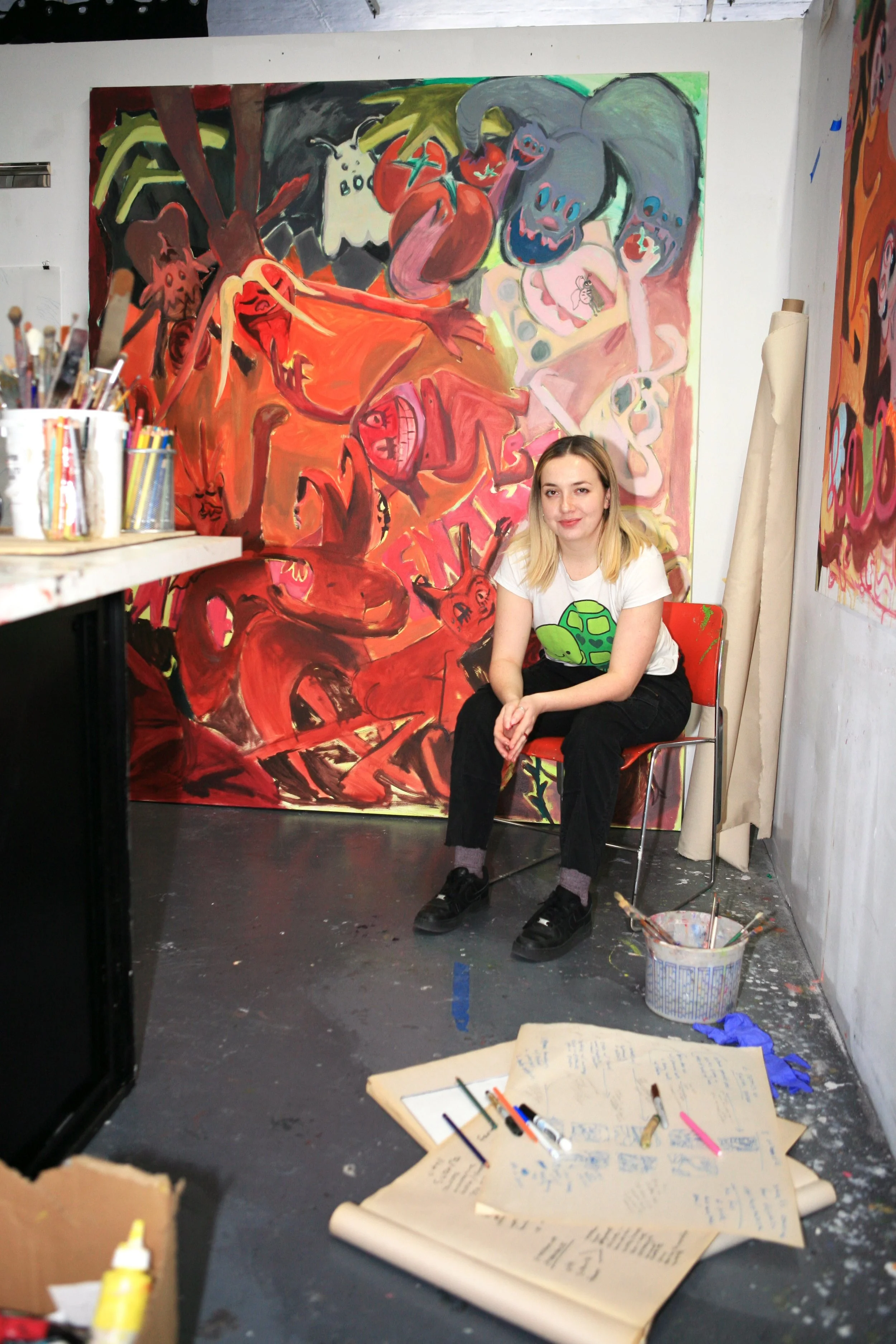
Lydia Crouse (b. 1995) is a visual artist from Indianapolis, currently based in Brooklyn, NY. She received her Bachelor of Fine Arts from the Herron School of Design and her Master of Fine Arts from Parsons School of Design, where she was the recipient of the Oscar Kolin MFA Fellowship. Crouse’s work begins as an effort to understand my interior life through painting. Using oil paint, she creates figurative dramas shaped by inner monologues—thoughts that are provisional, self-questioning, relentless and unresolved. Writing acts as a quiet guide, offering cues that lead into drawing, where fictional situations are staged. Painting becomes a site of speculation, a space where characters, landscapes, and gestures gradually reveal themselves, allowing abstraction to enter not as a resolution, but as an invitation to speculation.
How did your creative journey begin?
Honestly, some time ago! I always found my way to the art room in high school — during lunch, a free period, any excuse really. It just felt like something I was good at since I was a kid, and it made me feel good. I didn't take it seriously until I got into some really strong art schools out east, but none of them offered enough funding, so I stayed in Indianapolis for school instead, surrounded by the best facilities, mentors, and strong artists who became great friends, with a Midwest work ethic just like me. That's really what pushed me toward art as a career.
Even before that, though, if I really think about it, art had always been the language I used to work through anxiety and plain old weird times. It wasn't until graduate school, where I was constantly pushed to look inward, that I really started examining my relationship to my own art — seriously, I had never connected my psychology to my work before that; as crazy as that sounds, I avoided that part! I'm still figuring out the boundaries between making art for art's sake, for research, and for a career, but what's stayed constant is that art has always been how I understand myself and ground myself.
I was lucky to grow up encouraged rather than discouraged. My family never once talked me out of any of it. In their own ways, each of them is a hard worker, so my family taught me what ambition and hard work actually look like — showing up for the craft even when no one's watching, working a job to get to something better, not liking the job, taking risks, or having multiple jobs at once — and I just ran with that — all the way to New York!
How has painting helped you understand your interior life?
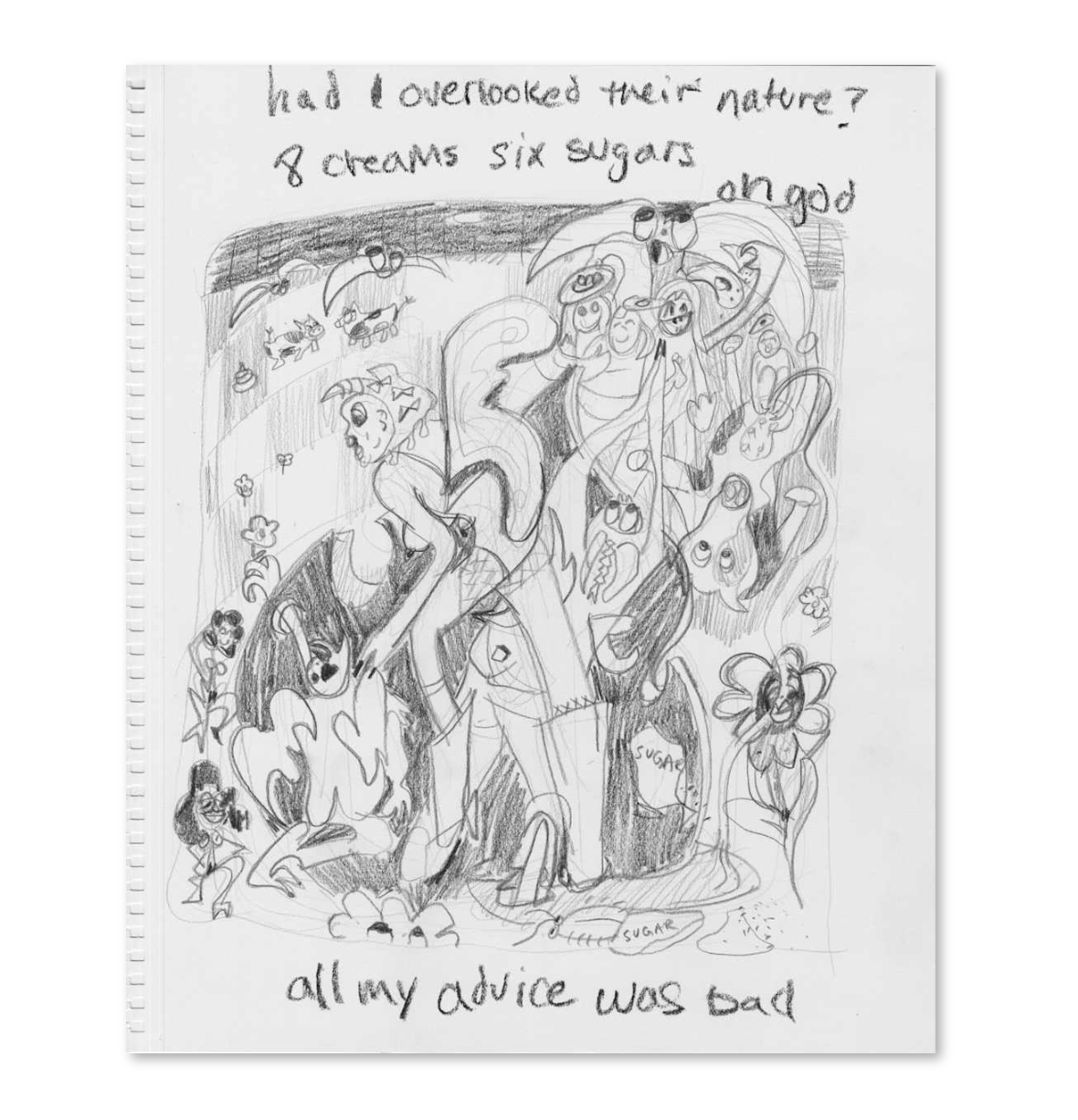
Wow, this question is so spot on for me right now. More and more, my practice is the attempt to understand my interior life — how I make sense of things, how I place myself next to things, the world. I get overwhelmed easily, I imagine in extremes, and my work leans into the anxious part of me that the rest of my life doesn't make room for. My process usually starts with text: repurposed diary entries, sometimes a couple of years old, and I mine for a title. Actually, starting with the title is worth noting. Rereading old journals is humbling, and definitely embarrassing, but it gives me a phrase to sit with and ask— okay, what else could this mean?
From there I loosen my grip on the literal narrative and let it open into something more fictional, while still working from that same interior headspace — nostalgia, everyday mundane moments, familiar landscapes, romanticized interactions, the things that keep me up at night, silly things, stupid things. I grew up visiting my grandparents' farm, lived in suburban neighborhoods, drove to high school with my friends — it was great. But childhood is such a strange time in retrospect, and my adult anxieties are totally irrational and imaginative, for better or worse, so I find myself questioning my own kid-brain now. I lean into that unpacking the way we do as adults, and sometimes I think of my work as just one big coming-of-age. So viewers might see symbols of the farm, suburbia, recovering catholicism, food, nature, working in restaurants — my experiences. Since I currently live in New York, that shows up too, through the pace of gestures, the actions and movements of figures, even small symbols pulled straight from my everyday, like the foolish pigeon in my recent painting.
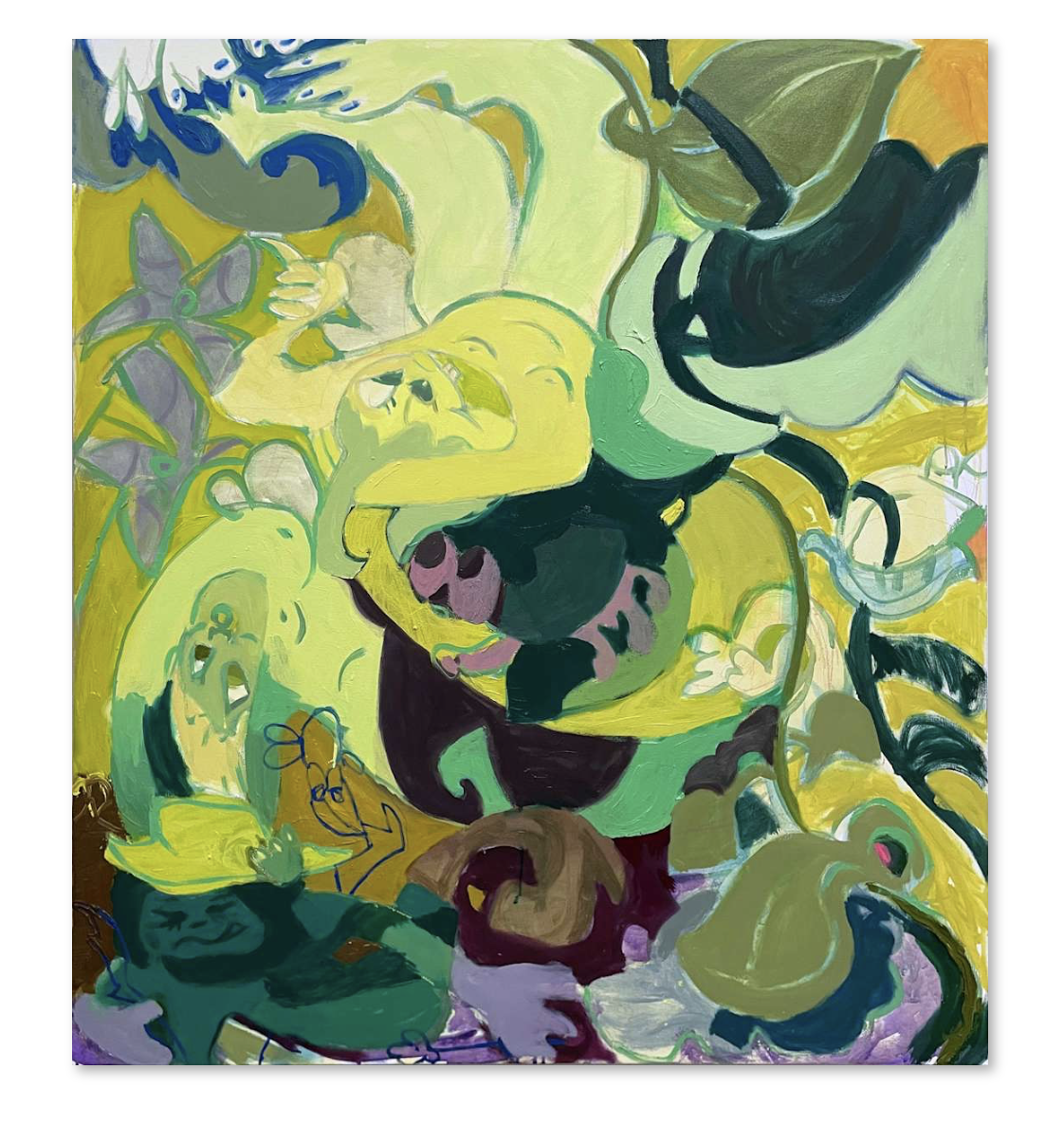
The figures that come out of this tend to sit in in-between states — naïveté, affection, embarrassment, longing, a kind of stubborn perseverance — and the landscapes around them are also fractured in a way. I plan my palette as best I can, labeling every color, but the medium always finds a way to resist that control, of course. So lately I'm learning to live with uncertainty rather than fight it, and my work has become a place for vulnerability, contradiction, and honest joy to just sit together without resolving.
What does a typical day in the studio look like for you, and how has your art practice grown or changed?
I arrive at the studio with my coffee, of course, and before I really touch anything, I just sit and look — for a shameful amount of time, honestly. I think about what I've made, or where I am mid-painting or mid-drawing, and I write down what I like, what I don't, what needs to change. Then I begin prepping my palette, which I sort of map out for myself in advance. That takes about an hour or two before I even start painting. I get frustrated easily, and like most of the artists I surround myself with, I've never had the luxury of unlimited studio time — I've always worked a job, or two, alongside making art, so my process has had to be efficient. There's a contemplative opening, a concrete middle, and then it all dissolves back into instinct once I actually start painting, which is the part I love the most. Even so, my practice has never been fully intuitive; there's always something I want to see that's really difficult for me to achieve technically.
That tension is real — between ambition and exhaustion, between devotion to the work, dreaming, and the limitations of the time I actually have for it. I don't think it resolves, so I try to let the work carry those instead: dominant tropes of certainty, religious doom, hustle culture, and emotional restraint. Recently I've shifted from working on one piece at a time to several at once, and I find I'm way more energized moving between multiple narratives in the same space. I also teach high school art at a public high school in Manhattan, and having twenty-five students asking for guidance on the fly has sharpened my own technical instincts in ways I didn't expect. They love to exercise my limits!
When choosing a medium to work in, how do you decide between drawing on paper, making a large oil painting, or something else entirely?
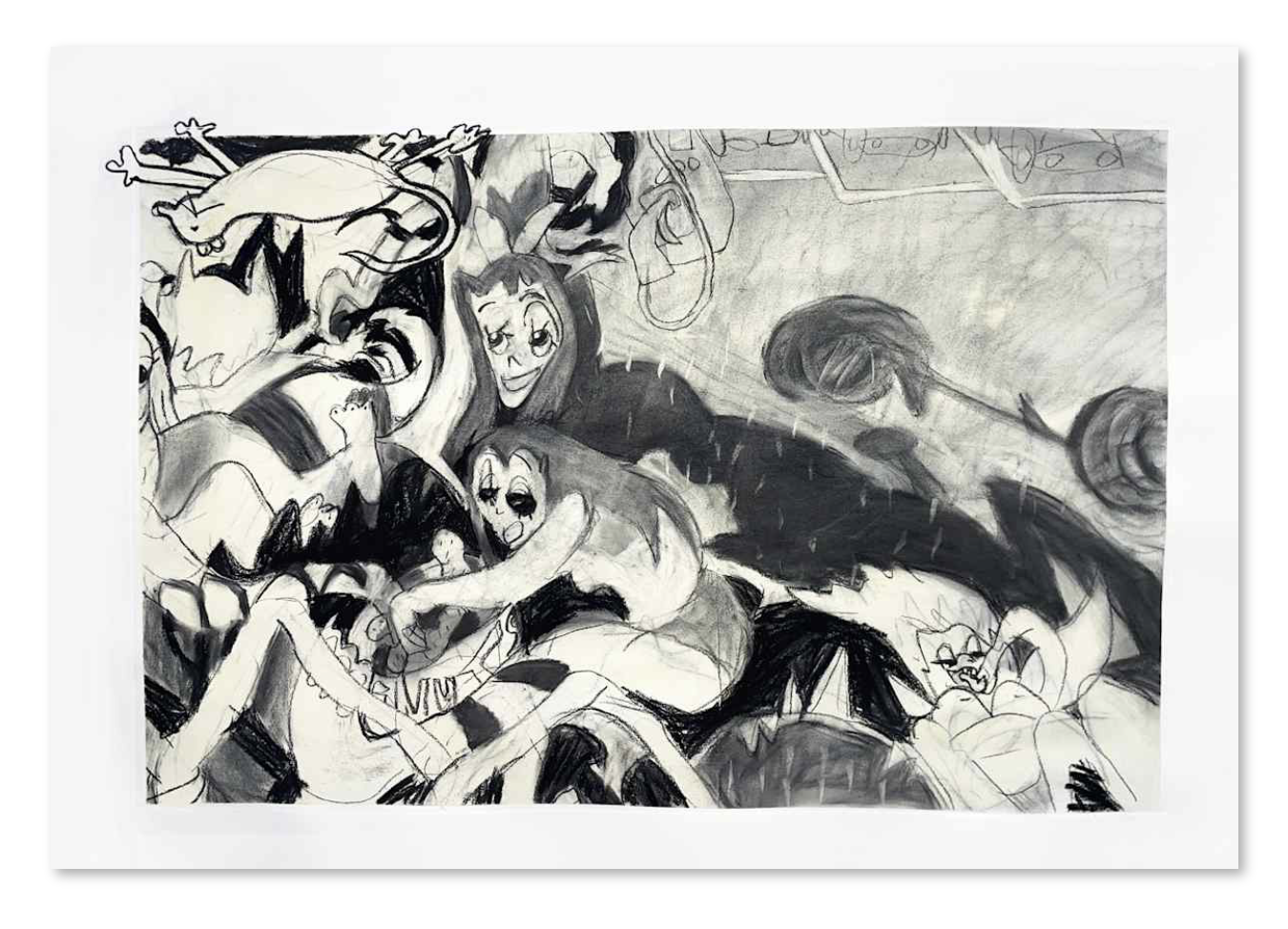
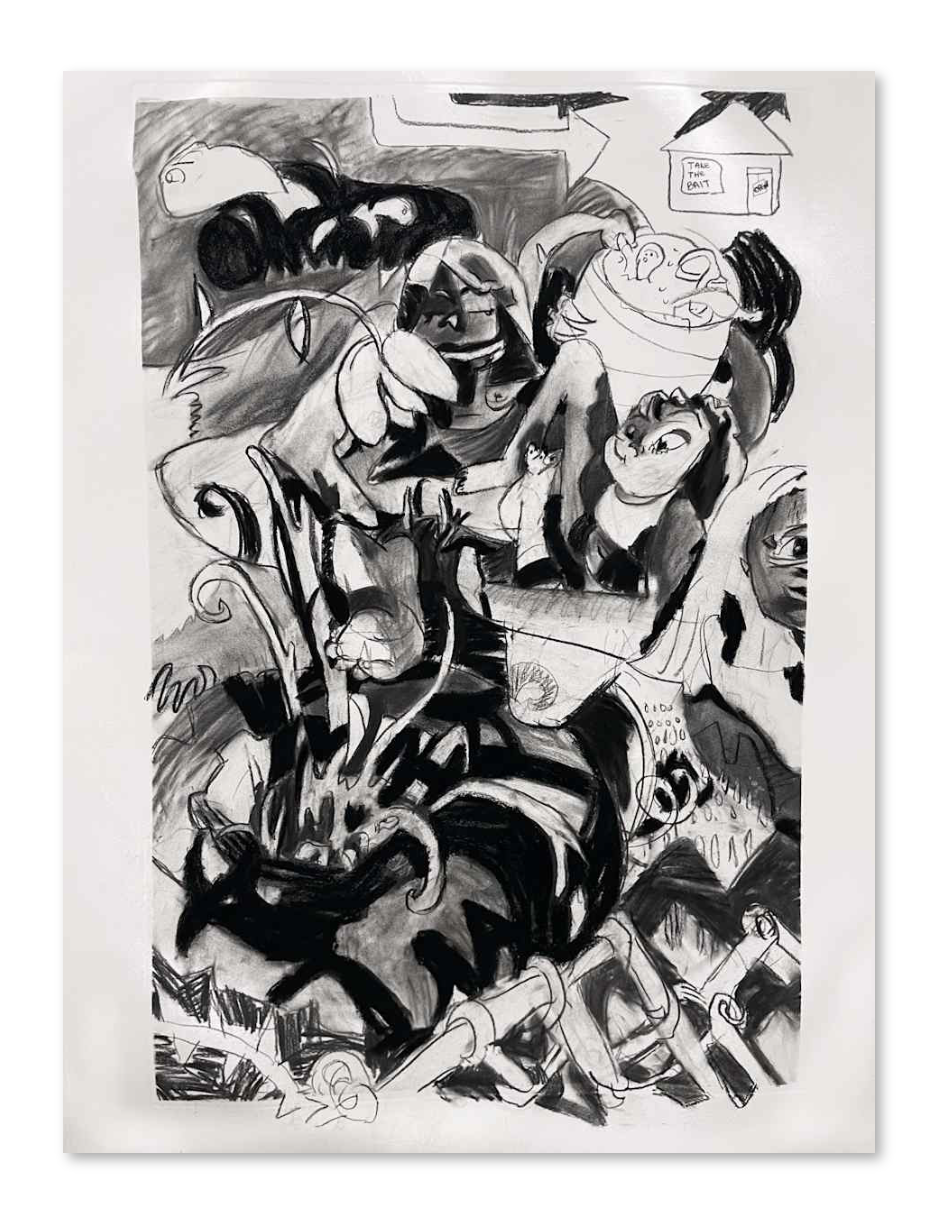
My process does have a natural order: writing comes first, distilled from journal entries into short phrases that become titles. From there, drawing lets me visualize and stage a scene — working out shadow, line, shape, and form before color enters the picture. Color is the part that overwhelms me most, and also the part that changes everything once it's added, so it comes last. I think of the drawings and paintings as separate, but in conversation with each other. So the order I work does feel natural, but it is not strict. There are days I want to do a color study before I've even finished a drawing. There are days I want to draw something I just encountered and then figure out the title afterward. I've also worked sculpturally, in printmaking, and in writing flash fiction alongside painting and drawing. I think I'll be moving into some colored pencil drawings next, which will be interesting since I've never done finished, formal color drawings before — I've mostly worked in monochrome for drawing and saved color for paint. So we'll see what happens once I let color into that part of the process too. I'm excited about it!
How has social media impacted your work?
Social media feels like something I have to participate in for the career-building side of being an artist, rather than something I choose to do for its own sake. I never expected it to carry so much weight when I started art school, back when it was mostly just for social purposes. I do use Instagram, and I do think about how my work looks to viewers online, but I really don't want that to shape the work itself. If anything, I've considered that conversation about the immediacy of pairing text and image — the same instinct that drives internet memes, a quick collision of language and picture that leaves room for the viewer to speculate rather than being told everything outright. That satisfaction is relevant to how I already think about my own work. But I think there are times when paintings speak for themselves — without the title I add. Some artists are genuinely gifted at social media as its own practice; I come to it in waves, and I'm still working out my intentions with it. I mostly value it for its accessibility — I mean, we can't all see the Mona Lisa in person, right? But I genuinely believe physical paintings are timeless in a way a feed never will be — I hope so, anyway.
Does narrative/storytelling play a significant role in your work?
Yes, my work is definitely one big ongoing narrative, and it's never really resolved. The drawings feel immediate; the paintings are more like a prolonged revision. I like to say my work is a kind of illustration, or a play, in both senses of the word — it's playful for me, but it's also meant to be read, meant to be seen. The titles function almost like fragments — confessions, jokes, half-formed thoughts pulled from old diary entries — refusing closure but insisting on continuity from one piece to the next.
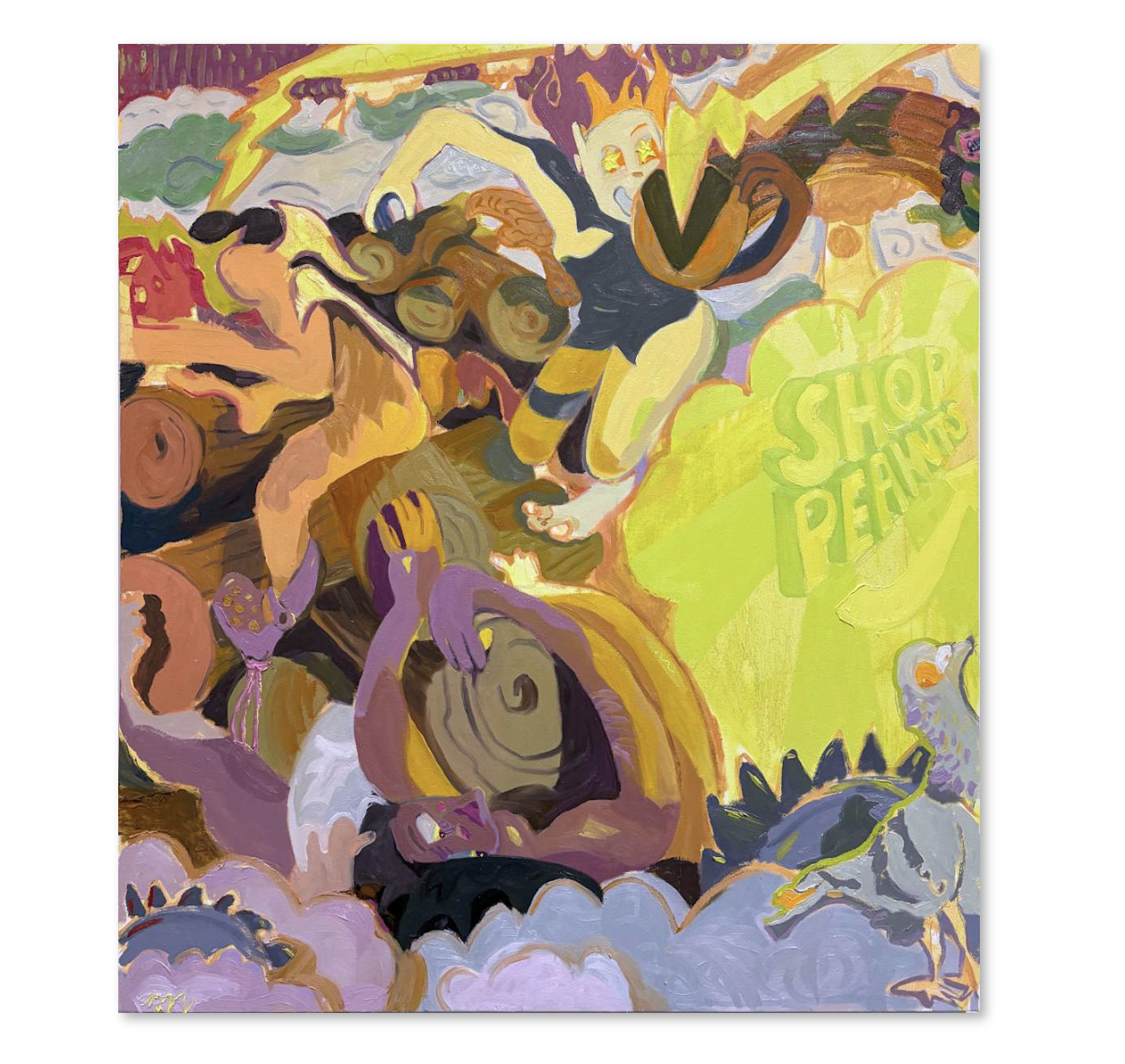
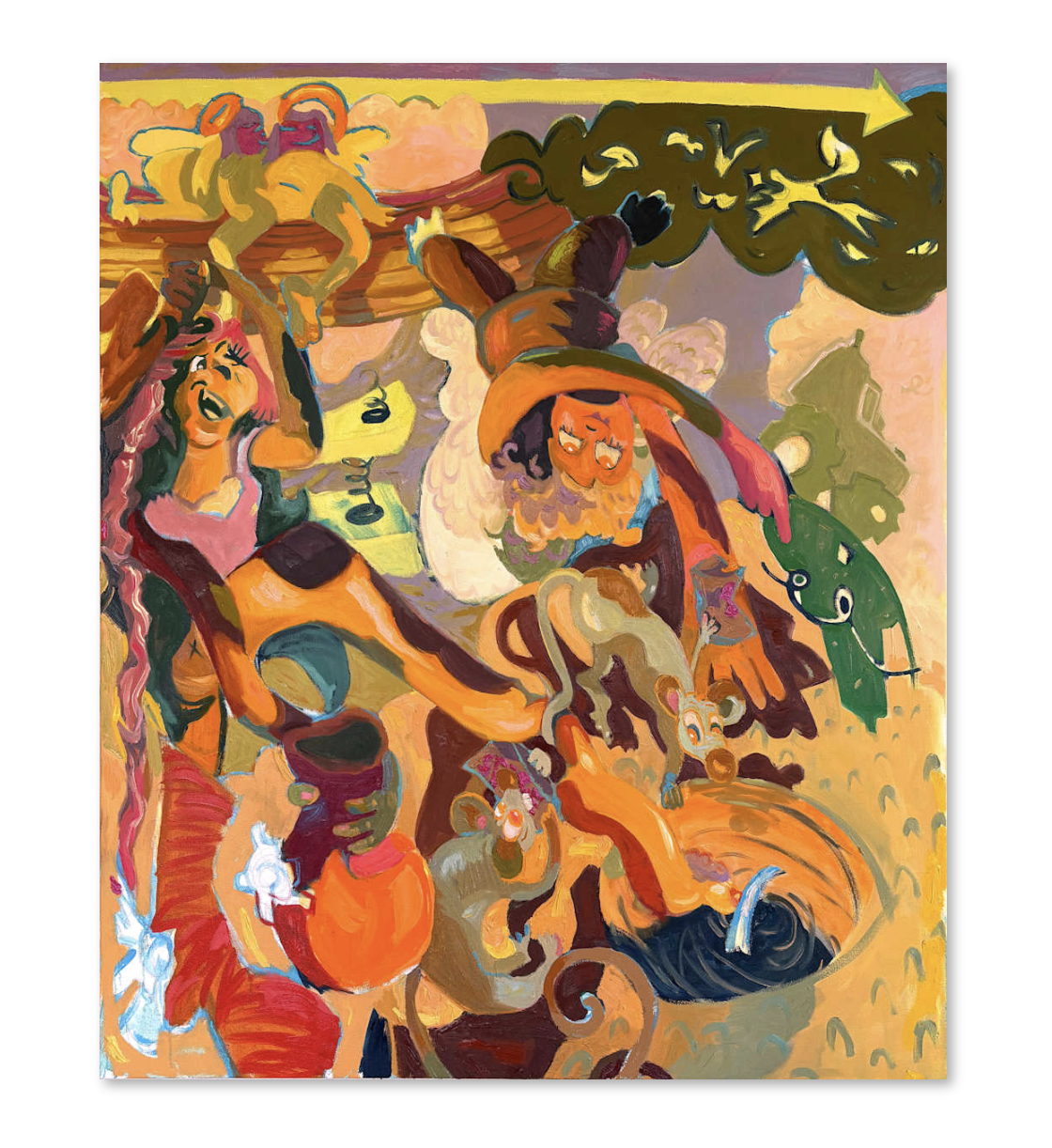
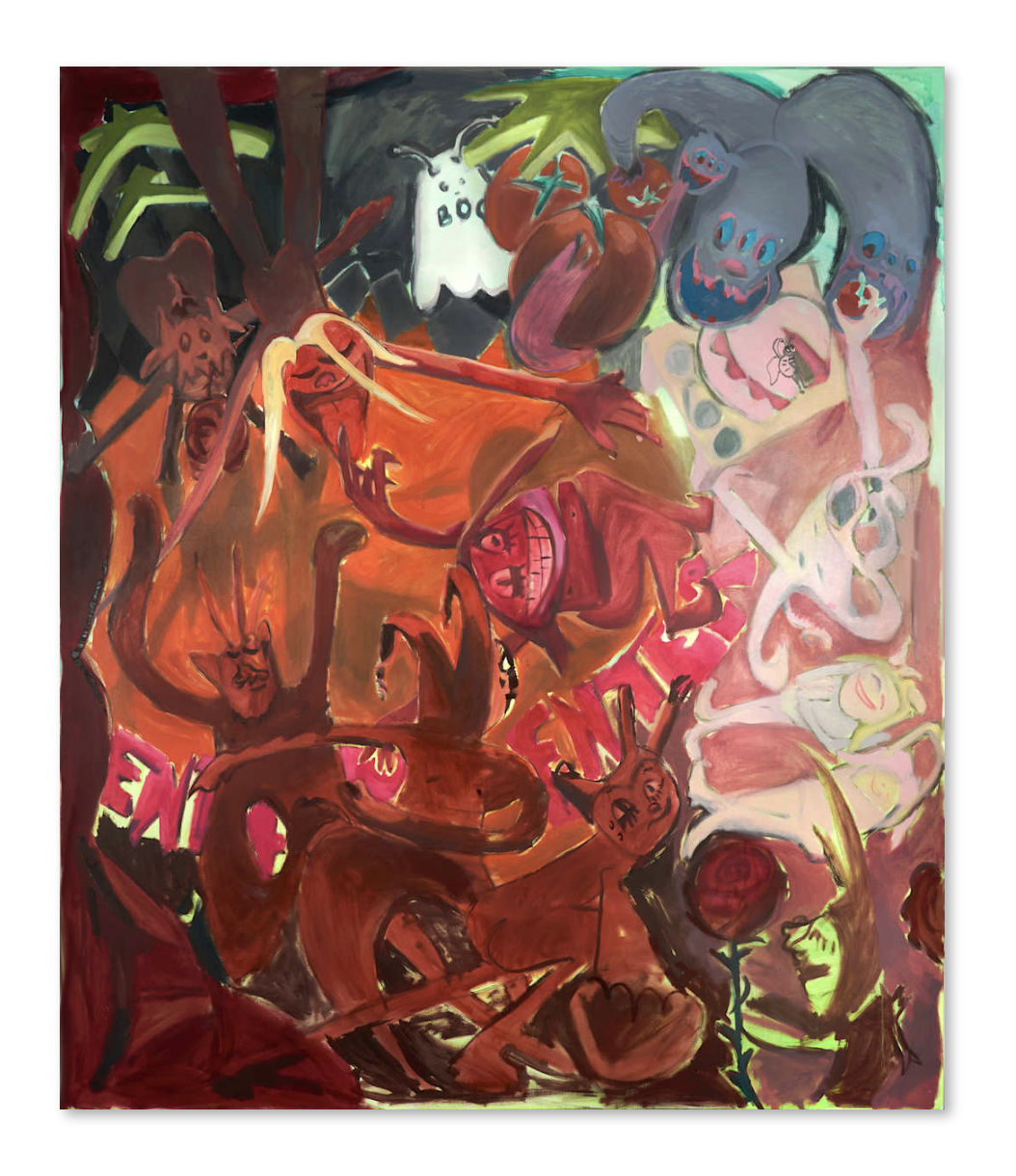
It's completely possible to look at a figure in one of my paintings and see it screaming, while someone else sees it laughing. That comedy, or comical duality, extends to how the figures appear, too — they might be monstrous but also cartoon-like, with moments of high light sitting right next to heavy shadow. Paradox shows up everywhere. That's how I exercise humor, sometimes dark humor — it's a comic relief tool I use to alleviate absolute darkness and my own fear. A studio visitor recently told me one of my drawings reminded them of "vintage Disney," which caught me off guard. I think my response was, ‘wow, don’t love that connection!’ ha— I'd never thought of it that way, but it's all there in my visual canon. Those particular animations are genuinely uncanny while still trying their best to be for kids, and I think that same tension runs through my work. I can describe a recent painting of mine, No time to really look: angel-like figures, somewhere between human and celestial, stack lightning-struck logs with their own bodies like oversized Lincoln Logs, while circular saw blades cut through fractured cloud shapes at the bottom of the sky. A pigeon perches on one of the clouds, completely unbothered, like a fool sitting at the edge of a cliff, while chartreuse sunlight breaks through the dimensional text "SHOP PEANUTS," with an arrow pointing toward the edge of the canvas. It's about hustle culture, survival, the next thing in motion — the sense that there's no time to pause, only to keep moving. That's usually the register I'm working in: urgent and a little absurd, with a subtle nod to my own experiences, like sitting in my grandfather's woodshop eating ‘shop peanuts’ while he works. The stories I share are personal, but they extend outward, beyond just me. Viewers might find confusion in it, may not see anything I just described, but something a little silly, a little colorful, something that sits with them a bit longer before they move on. Control gets deliberately loosened throughout this whole process; I'm less interested in dictating a single reading than in staging a scene of tension and play and letting a viewer find their own way through it like I am. That's the ambition, the goal.
What kind of emotional experience do you hope viewers carry with them after encountering your work?
I want viewers to slow down and take in the good, the bad, the ugly, the romance of it all. I use that word a lot — romance — and it's funny, because once I started teaching I had to explain the history of Romanticism in art to my students. It's not the kissy-huggy kind (insert visual of 25 teenagers cringing at your word choice), though that exists in my work too. It's more than that: raw drama, intense lighting, sometimes horrific, or a sense of something larger than you — spiritual, sublime, truthful. I'm a skeptic, but a total die-hard romantic.
So yeah, I want viewers to carry some of that with them — to speculate the way I do while I'm making the work, and maybe see something hopeful in it too. Some artists are really amazing at telling you how it is, the state of the world, period, full stop. I admire that, but it is not natural to me, as I think I am learning as I go. My goal is to get at something without saying it outright because I don’t really know it either; I guess it's like the way spirituality gestures at the divine without ever naming it directly. Abstraction is how I do that; I often don't fully know what I'm saying until a painting is finished. Every piece has a counternarrative built in — what looks at first like a colorful hellscape usually opens up into something more hopeful, often mundane, and totally human.
Ultimately, I want the work insisting on softness, curiosity, love, and imagination as real tools, and I'm asking, along with it, what it means to stay emotionally available under conditions that mostly reward detachment and speed. I want it read as much as be seen — a play unfolding across images, embracing absurdity and affection in equal measure. Ultimately, I make paintings to understand myself and my place in the world, and to set the stage for viewers to consider the absurdity of our endeavors, and maybe the possibility of love in the face of any antagonism.