Corrine Yonce: A Place of Discovery
Corrine Yonce is an artist, affordable & Fair Housing advocate, documentarian, and communications professional based in Winooski, Vermont. Yonce combines visual art and ethnographic media, including audio interviews, household objects, and photographs. Her figurative paintings and installations dig into the concepts of home and housing from a community and personal perspective.

How did your creative journey begin?
I am not sure “creative” was ever a conscious choice for me, so much as it was a way of navigating, processing and communicating to the world around me.
I have three siblings - all a year apart- but have been the designated “artist” since I entered grade school. I moved a lot growing up and navigated learning disabilities that many of the smaller schools couldn’t accommodate. Writing and drawing was a shield, a tool for grounding in new space, and a way to keep my mind occupied when I had no idea what tf was going on. Our mom raised us largely on her own. On the days we weren’t recruited to help clean rooms (my mom managed hotels growing up), we would spend a lot of time at school after hours.
During a particularly dry school budget year in high school, someone donated oil paints. The training for the novel material was beyond the regular studio classroom curriculum, so a teacher gave me special access. She even gave me a cubby in the hall so I could use materials when the classroom was locked after school. Oil and acrylic paint was the medium I didn’t know I was looking for. While I was an obsessive journaler and drawer, public school drawing and painting (always watercolor, previously) curriculum bored and frustrated me. It was like trying to unfurl the ocean through the restriction of a faucet. I desired scribble, pours, and squishes.
By the time I was in college, though, it was pretty clear that an art major was a damning diagnosis for a family with negative financial cushions. I attempted a bio major thinking I could go into environmental conservation, and a near-failing grade had me sneaking back into the art major (softened the blow by double majoring in English). I haven’t looked back since! It was like a slow march to imminent- but gratifying! -doom. When I completed my undergraduate, I stayed plugged in by TAing for my former professor. I split a studio with a friend in a defunct public works building. Eventually we started organizing our own shows and art spaces. The hustle has never left!
How do you decide when an object belongs in a painting versus remaining outside of it, still holding its own story?
That’s a hard one. Objects usually live a full “second” life with me before they’re pulled into the gravity of a painting. And every painting has its own growth cycle- it has made it challenging to narrow in on materials or to make in sequence because the paintings come together so differently. As soon as I develop a formula, the next painting rebukes and overturns it, sending me into an existential spiral. The range in the works - the way my attention was pulled in the endless material possibilities - made critiques challenging, especially in the early days when I didn’t have enough work to find pattern in it all.
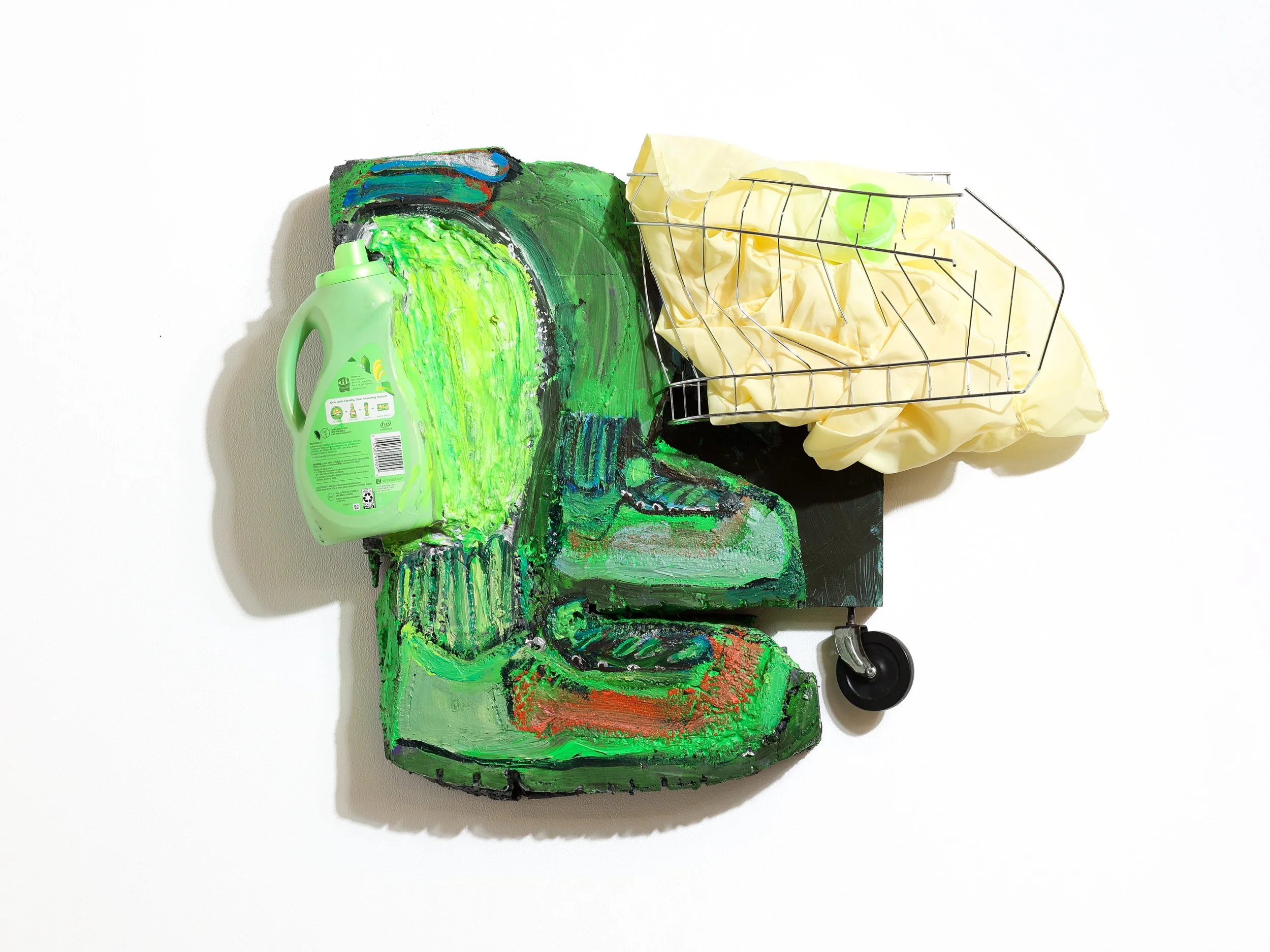
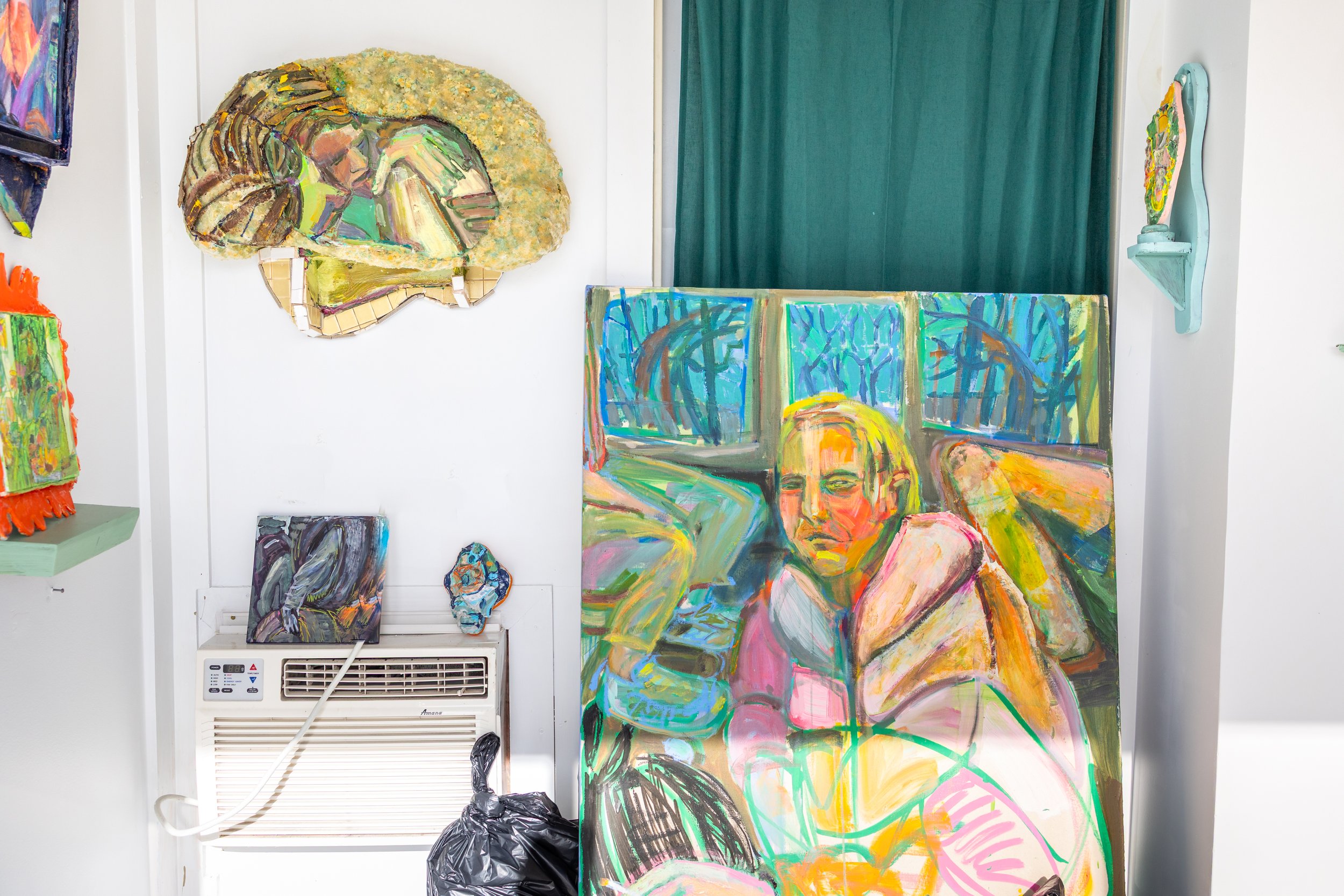
If we look to my laundromat painting series, the Glad laundry detergent bottle arrived at its resting place differently than the Adida’s shoe. The paintings all started similarly- drawings were from observation of people using the space and the color palette was sourced from the foundational colors recurrent in the landscape of the laundromat. I layered drawings atop one another to create the design of each work. By then, I had moved off the canvas to more additive materials- plaster, cardboard, resin, insulation board. The laundry detergent bottle was sourced directly from the space- abandoned and empty. But the Adidas shoes first cameoed in the drawings of people using the space. I reached out to a friend who up-cycled clothing and worked at a second hand store- she happened to have discarded flip flops.
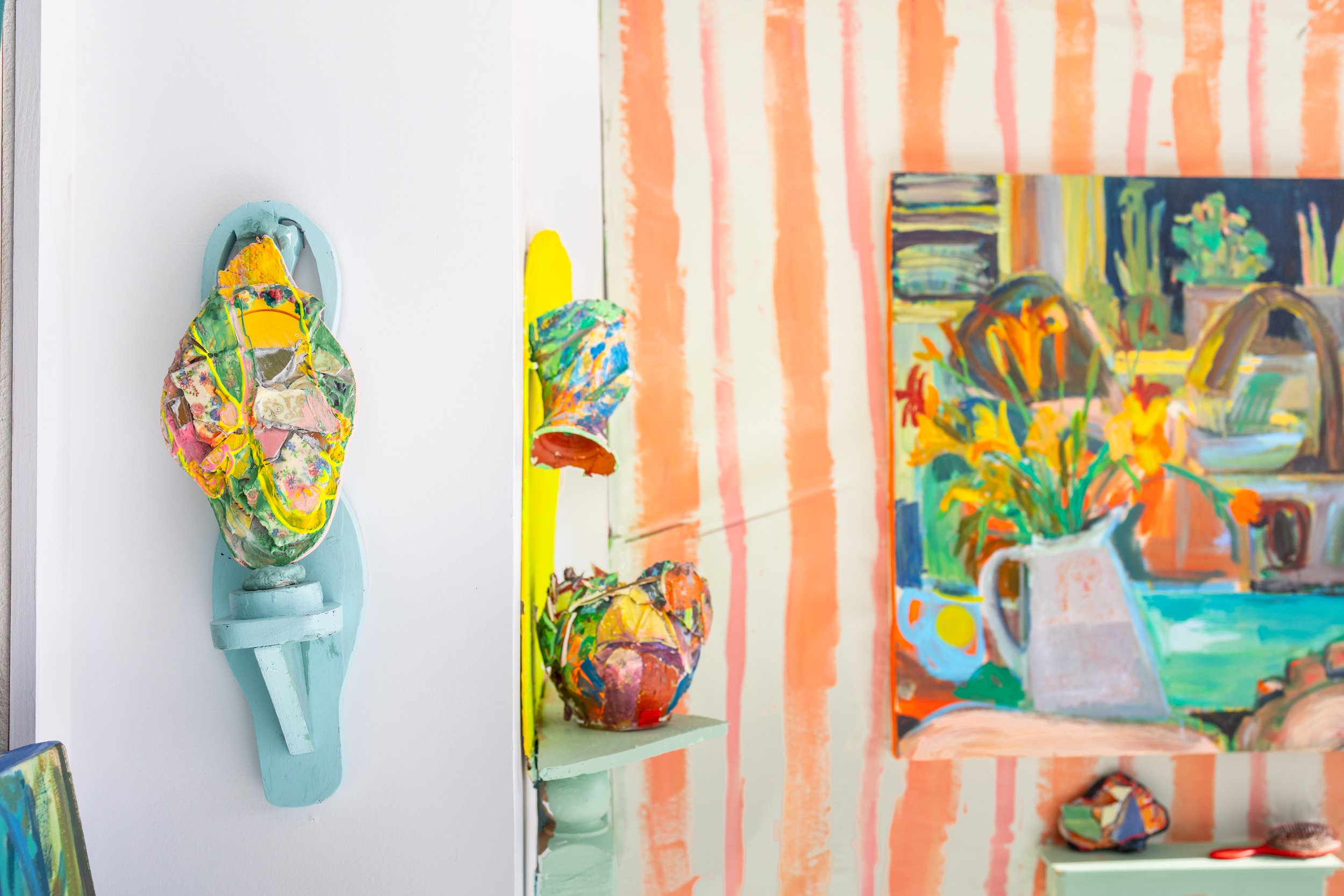
Using objects in the paintings taught me to see material as color- as much pigment as the paint itself. The objects pushed me to build each painting as layered color and material. The surface no longer was afforded “the pass” that it was simply in service of the painting- surface is the painting, too. When I add plaster and grout, I can choose to pigment it to steer the work towards a color space. Or I can allow plasters’ chalky white or grouts’ cool-grey to exist as its own mark and hue. There’s certain local colors I’ve come to love- like the grey-pink of insulation foam board. I find it in chunks along the Winooski riverbank, edges rubbed round and pockmarked with insect holes like Swiss cheese. It was especially abundant in recent summer from historical flooding- remnants of former shelters shattered by water.
What does a typical day in the studio look like for you, and how has your art practice grown or changed?
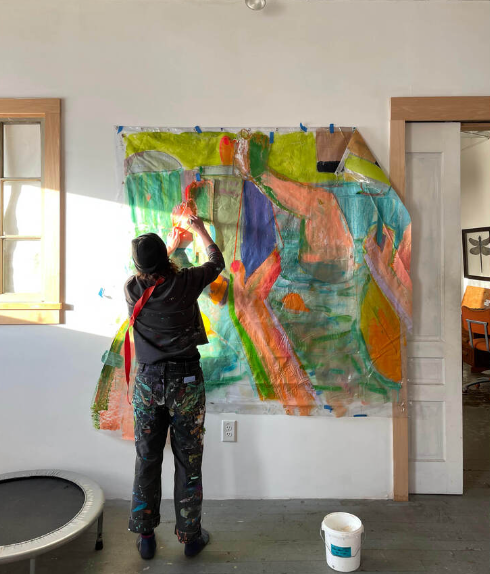
I have a couple studio tracks- sometimes I start at my office and walk over there midday or I’ll start my work day right in the studio. That way, I can be looking at my paintings while working on other things. It sounds crazy but I swear most of what I do in the studio is just look at things and move them around. Sometimes it’s straight-up a studio day, in which case I usually try to do the ever-necessary cleaning and *then* return to the looking, shuffling, staging. I recently inherited some amazing studio walls that also function as storage, so I can have work for looking and a working wall. I use a lot of references- objects, photos, drawings, drawings of drawings and of all the other stuff. I also just kind of need the abundance of material to feed my creative juices.
But it’s really important for me that my studio work isn’t limited to the studio. I draw a lot. I use a daily notebook that’s mostly endless notes of tasks and planning my week, but also lots of quick gestural sketches. At home my sweet patient partner organized all my drawing materials (markers , pencils, pens, crayons- nothing off limits (except now wet media- too many home accidents with resin!)) by color. A perfect slow evening has me drawing after dinner- maybe pulling other drawings together, or looking at art history textbooks, or just drawing from observation.
My iPad is an incredible drawing resource (different though!) in that it allows for drawing in different places that would be challenging otherwise- the bus or plane, at night while my guy is asleep, waiting in the doctor's office.
I’ve always had to juggle multiple jobs to meet my expenses- which is not always true of my peers (especially in the area I have lived- the cost of living makes it hard to start off without family support!). So my studio experience has had peaks and valleys. However, I’ve had a studio since I lost access to my undergrad facilities- not even really thinking too deeply about it. I made it work financially by splitting small spaces, and slowly let myself invest in more as I could. What I have found, having now gone to grad school and expanded my art community in ways beyond my younger self’s imagination, is that the commitment to having a place to make art not only formalized my art practice, but naturally spun a maker-community web. Having people in your life who are equally nonchalant but invested in their art practice is huge. There’s the obvious ways- having people to give you feedback on your work, to push you to visit and make work you might not have otherwise, with fabrication skills to share, exchange and teach. But the subtle and important thing working along other makers does is validate something potentially “financially risky” or “impractical” or “illogical.” So much of the artists’ life is doing things that are very cumbersome- physically, big time commitments, so much shuffling of stuff. The work is hard enough without the added exhaustion of trying to justify or explain why it makes sense to bank vacation time to pull 12 hour days of manual labor while training community members, or what the value is of renting a haul to drive a sculpture up state, only to then need to rent the Uhaul again to haul it back. This is not to suggest the artist’s life demands pushing your practice beyond the boundaries of your physical limits (but if you have another way, please let me know because I’d love another way!). More to highlight the value of having a community of makers who understand labor that isn’t driven by value, product, or ease. I find my artist community is more than an art support system- it’s a place where my whole identity is inherit. My trade, sex, gender, presentation, genders I’m intimidate with, ways I communicate and take up space coexist without question. I’m not filtering and squishing down into what I think is expected or palatable. This is my experience in my Art Community, my built and expanding art family. It’s not to say, “I’m without privledge there” nor to suggest that art spaces are without prejudice or hierarchy. Being an artist means building that family, the people who not only hype you up when you put in endless hours for an install that’s open for only four days, they come to the opening and then pick up your unboxed , cumbersome flip flop painting from the obscure remote sculpture space you abandoned it last spring.
The way you hang and install your work often resists traditional display. What does disruption or instability in presentation allow you to communicate that a conventional canvas cannot?
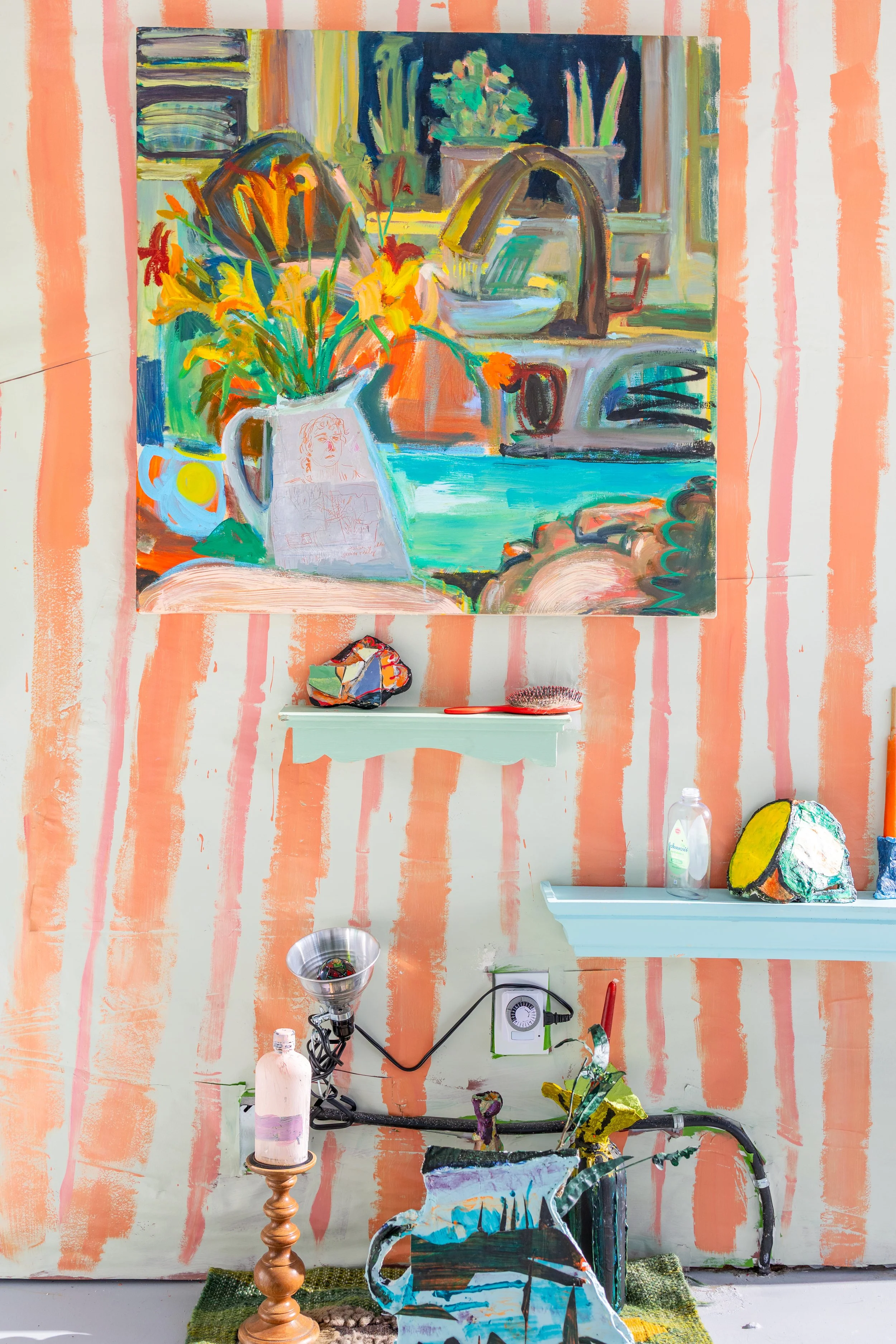
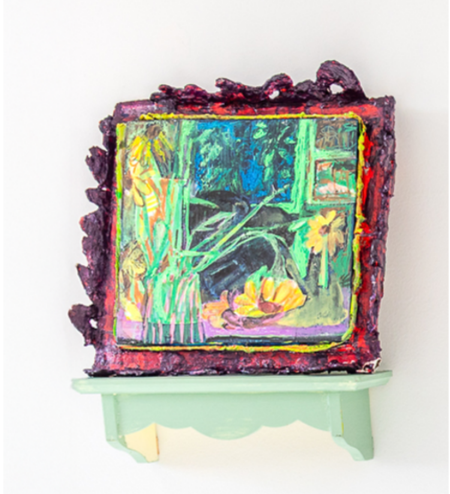
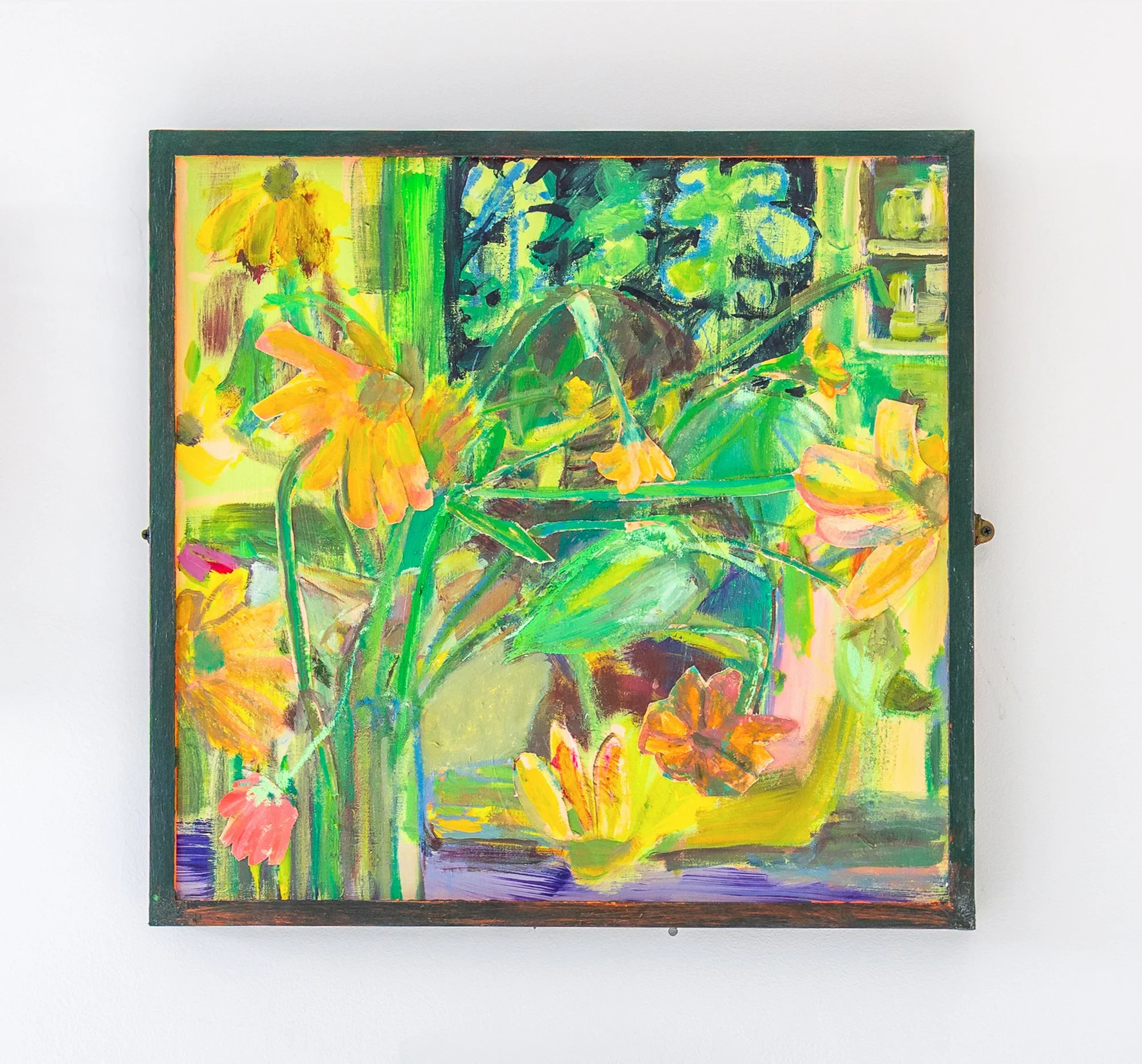
Painting, for me, is a place of discovery. So while there’s a lot of practical justification for a painting the hangs on the wall like a mirror or a mounted tv, and an art object that sits on your bedside table next to the lamp and your morning meds, if I follow only what I know, how am I supposed to be surprised?
Unsurprisingly some of the strongest cues I’ve started weaving into my paintings are from grad school- weirdly, a lot of those moves stem not from the crits and studio work, but from the schlepping. I live comfortably with not a lot, but I desire abundance in the studio for my making. While I’m not above camping in a dorm with a sleeping bag and rotating my three painting outfits, my studio juices are my high maintenance alter self, doubling down on all the extras I could live without. The choskies! Toys! Delightful and tactile discards. The frugal space making followed me into my living space. When I needed a bed side shelf I made a temporary one like I did in the studio. My empty kombucha and wine bottles became book stops and adornments. The materials I didn’t use at the studio adorned my walls. From there it just kind of made sense for things to occupy unconventional spaces- humor, resourcefulness, hardly hanging on.
It meant going to and from the studio was a lot more laborious than the ten week bike trip I thought I’d model my packing after (where my life fit in on tote!). The most emotional part was departing- it was far easier to ship my art supplies to the studio than ship the resulting artworks back home. By the time I entered my second summer of schlep, I had finally recognized the old, familiar packing/ departing spiral that I would enter- I was reliving my journey of being location!
As I mentioned, I moved a loot growing up. My mom has always struggled with addiction so early in childhood the moves became necessity rather than by choice- our house was foreclosed on when I was 11 and our living arrangements were mostly temporary and almost always contingent on romantic relationships since. I learned the hard way that anything I wanted to take, I had to pack and load.
Even in young adulthood when I was living alone, my credit had been damaged by my mom’s spending and I couldn’t be on most leases, resulting in temporary (and often illegal) sublets. I didn’t have a car or even a license for a long time, so every move became a juggle of favors, discarding things that were too hard to figure out, trying to minimize how much stuff I had and move as much as I could before asking for help.
The irony of the low residency program was that my incentive came a lot from this place- I was still pretty new to housing security. My mentors and artists I idolized painted a future of moving every couple months of years, sometimes months. I only just found a doctor I trusted for chronic health stuff, my first therapist- the place where I could get my taxes done for free
How has social media impacted your work?
Social media!! Aaahh.
I’ve never quite hacked social media, though I think I’m starting to fake it better. Honestly for a while it did me dirty- there was a moment when I thought I could pull off self employment. There appeared to be an abundance of makers in my community. I took a lot out free financial literacy and micro business classes. The thing I realized much later is that the “marketing rhetoric”
That works for most businesses, even creative businesses, is antithetical to my drive for making. I tried to parrot what I was seeing- most clumsily mascarding as an influencer, positioning my art in somewhere scenic with a romantic selfie. Alas, I’ve always been awkward in front a lens. The attempts remind me of when I started a new middle school with Ivy-league kids, after spending my elementary school years with the same 8 farmer kids. I eschewed my zip offs and cargo pants and flannels, and begged my mom into buying me a horrendous pleated hot pink plaid skirt. I never quite figured out what didn’t “work” with that skirt, covered in part by my oversized white(ish) off-brand polo shirt. Social media can be like that skirt!
But social media is a connective tool at its core (or maybe just at its best) and I continue to make in Vermont, 6 hours north of the US’s “art epicenter.” I think social media has made notoriety in rural communities more possible- but the possibility owes credit too to the pandemic. Lots of artists moved out of the city during lockdown, and contractors are becoming more used to visiting studios outside of their regular orbit.
There are many artists I have first discovered over Instagram- and enjoyed from that initial point of contact! But the best paintings still hold 90% of their magic from that in-person bodily relationship.
Social media is complicated- like relying on airplanes during a time of climate crises or washing your acrylic-covered brushes in the era of micro plastics. What are we doing? How do we sustainably stop?
Has your long-term collaboration with housing communities changed the way you think about authorship in your work?
Housing advocacy and organizing for the longest time felt as disparate to the world of painting as two things can be. Exploring painting for the sake of painting in academia when your neighbors are experiencing exposure and hunger? The gall of it! My material and observational curiosity in painting felt so out of touch from the conflict and needs I’d be responding to in my housing work.
There’s no question of the imprint my housing community has had on my understanding of self and how I relate to the region I live and work in. Housing organizing and education has helped me understand my own housing history and how that lives in who I am as a person- my failings, my sensitivities, my power. My empathy and drive has been fed by the leaders I have learned alongside, my mentors both in the professional housing spaces, living in housing precarity, and everything in between.
One of the profound realizations I have arrived at in pursuit of an art education while sustaining my career in social services is the resounding impact of language. My thesis in graduate school was born of mis-translation of the word home, shared in vastly different spaces- folks in my graduate program couldn’t see how my work was about home, when there was no structural reference to “home.” Where’s the windows and doors? Meanwhile, I was frustrated in my community housing outreach when - when engaging folks in housing content through art - people would respond unfailingly with the iconic triangle-topped-square. In the housing world, this depicts a “single-family-home,” a structure most of the people we worked with didn’t even live in. The realization hit in cartoon-cliche fashion, a light bulb somewhere turning on. My work in both spaces crystalized around the mission to shift our understanding of the word home in terms of relationships, memory, safety, shelter- all the things words cannot quite capture.
What kind of emotional or spiritual experience do you hope viewers carry with them after encountering your work?
The thing painting does for me that feels un-replicable by digital medias is operate in a space of nuance and dynamism. It can sit so stubbornly in between spaces, shifting even in its stillness between different translations and reads. The context a painting is displayed in adds so much vocabulary to how it’s read and understood. I am a sucker for the both/and. I want things to feel personal and specific, but legible to a wide range of audiences.
Someone once told me that art’s power lies not in the instant change, but the slow progression. They said, “If someone walks away from my work and starts doing or noticing things a little different, no matter how small, it is a success. Maybe they just make cookies a little different, and maybe they don’t even know it was in response to the experience of the art piece.”
Now’s a time of hyper saturated communication. Words and images hold our attention constantly. Advertisements are our background soundtrack as the digital space leaks into the mundane- the refrigerators and light fixtures get smart, our connective devices - phones computers texting- are all plugged into the internet. Video (!! *explosion emoji*!!) is the best and most to hold our attention, but only for that 30-second-duration. Our beliefs and assumptions are reaffirmed by our algorithmic content. Even AI art is showing us what the formulas think we want. Painting is a place for surprise, discovery, pause. There’s no greater reward than watching someone think they understand a thing, but slowly realize there’s a deeper read, a figure or an object they missed. My favorite moment was when my work colleagues - folks hailing from all sorts of different countries, of different ages, covering a vast array of cultures and aesthetics but tied by our work - visited my art at the laundromat. Their wonder and confusion at the material, their curiosity in the drive could keep me going for years.