Andrae Green: A Journey of Becoming
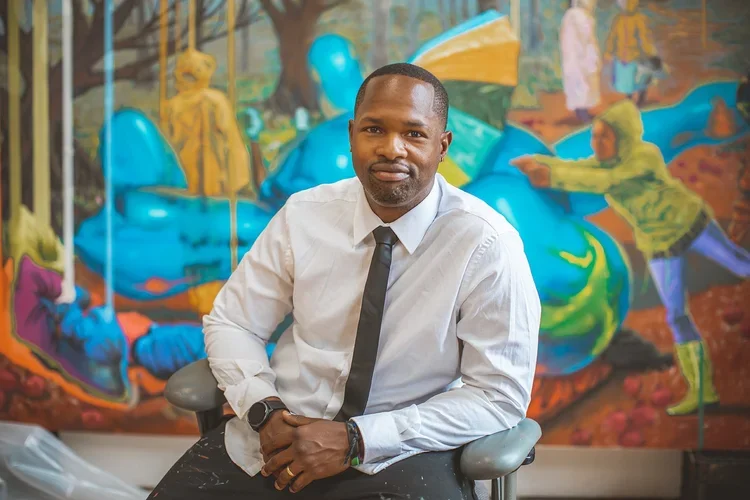
Originally from Kingston, Jamaica, Andrae Green discovered art through the comic books of Marvel and DC, which was the only art resources available in his youth. Growing up in a community marked by economic hardship, social upheaval, and the constant specter of violence, he found refuge in art, school, and church. These three domains kindled his inner world and led him to invent sci-fi and whimsical characters embodying hope and freedom. Now working in Western Massachusetts, Green’s paintings investigate the emotional and spiritual dimensions of lived experience, especially within family relationships. He doesn’t merely depict events; he conveys their deep impressions. His work blends existential and Judeo-Christian motifs with elements of speculative fiction, aiming not to dwell in despair but to illuminate vulnerability, optimism, and desire in ways that speak to our shared humanity and collective unconscious.

How did your creative journey begin?
The Genesis of the Journey: Zinc Fences and the Dual Sanctuary
My creative journey did not begin in the sterile quiet of an academic hall or the polished environment of a gallery; it began in the rawest, most visceral way possible on the cool tile floors of my family's home in Kingston, Jamaica. I was surrounded by the vibrant, chaotic energy of the city, specifically within a "concrete and zinc" environment. In this world, political volatility and the ever-present threat of violence were not just news items; they were the very atmosphere we breathed. To navigate this, I found refuge in two distinct but overlapping sanctuaries: the church and the pages of Marvel and DC comics.
I was the quintessential "weird kid," a conservative church-goer who was constantly scribbling. My friends from those early years still joke about how I spent every sermon no matter how fiery or moving deeply immersed in drawing within the pews. They saw the trajectory of my life long before I had the clarity to understand my own destination. My childhood was a stack of comics where Captain America, Superman, Conan and Spider-Man were my first "Old Masters." The illustrations of Mark Bagley and Todd Macfarlane consumed me. I learned the language of anatomy, drama, and heroism from these artists before I ever saw a formal painting in a museum.
The real shift in my life occurred when I left the island of Jamaica for the New York Academy of Art on a government scholarship. This transition was more than a change in geography; it was a cultural and spiritual realignment. Suddenly, I wasn't the outlier anymore. I was surrounded by other "weirdos" who shared this visceral, all-consuming obsession with the craft of making and the figure. It was in this environment that I realized art wasn't a hobby or a tangential interest; it was a mechanical and spiritual necessity. I tell my students all the time that I am only the best version of myself; the best husband, the best father, the best son when I am in the studio "exercising my demons." There is a professorial labor to this; you have to grapple with a deep struggle, push through the "dark night of the soul," and solve those internal preoccupations on the canvas. Only after that grueling process do you hit the epiphany where the viewer can finally feel the weight of what you are doing.
You discovered art through Marvel and DC comics. How did comic book storytelling shape your visual language and sense of narrative?
The Visual Language: From Peter Parker to Alberti’s Infinity
The narrative structure of my work is inextricably linked to my early love for comics. I have always identified most deeply with Peter Parker because his status as a hero is so profoundly human; he isn't just an alter ego, but a man navigating the friction, bills, and relationships of everyday life who happens to be Spider-Man. That philosophical lens viewing the hero as a person in a state of constant struggle is baked into the structure of every painting in my current series, "Divers."
In academic and technical terms, I examine my compositions through the lens of Alberti’s perspective. I believe that a fixed point in space is not a limitation, but a gateway to infinity. By embracing a specific constraint, a single moment, or the two-dimensional picture plane itself, an entire world of infinite possibilities begins to emerge. I am fascinated by the "arrested moment"—that specific snapshot where the past and the future collide within a single frame.
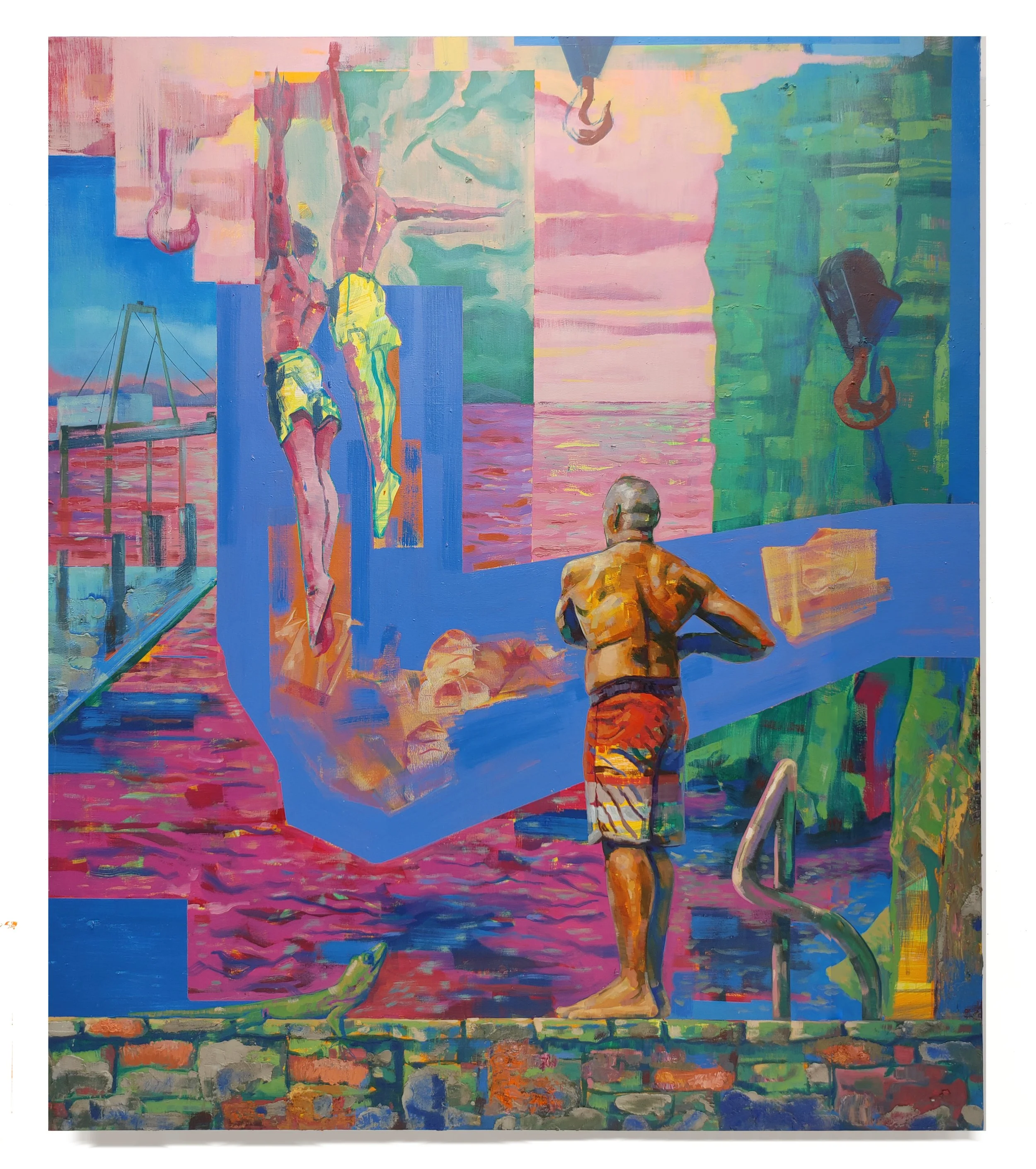
This approach is heavily influenced by quantum mechanics. Specifically the theory of Quantum Superposition and the Many-Worlds Interpretation. This theory suggests that a physical system exists in all its theoretically possible states simultaneously until it is measured or observed. In pieces like Icarus II, the figure is caught in mid-fall, yet that single snapshot serves as a nexus for multiple narratives: it alludes to the biblical Fall in the Garden and echoes the charged tension of Michelangelo’s Creation of Adam etc. Many historical and spiritual moments are captured within one. I try to explore the idea that every probability is a reality, where a solitary moment in time echoes other shared experiences.
On the canvas, I can hold the simultaneous truths of a person jumping: the jarring moment of landing, the fleeting moment of escape, and the quiet moment where nothing happens at all. To me, all these realities are valid and exist together. Comics gave me the permission to see the world as a series of connected, nuanced leaps into the infinite, teaching me that the body is the ultimate vehicle for this narrative drama.
What does a typical day in the studio look like for you, and how has your art practice grown or changed?
The Studio Alchemist: Discipline, Risk, and the Fractal Loop
A typical day in my studio is a balance of technical discipline and sheer, gut-level freedom. I begin my process with "bozzettos"small-scale mock-ups that allow me to lock down the composition and structural integrity of a piece. But the technical preparation is only the foundation. Once the actual act of painting begins, it becomes a visceral, physical experience. I have often said that I work until I "salivate." There is a cerebral and physical feedback loop where your mind tells your hand what to do, your hand tells the brush, and the brush responds to the surface. It is a fractal extrapolation of my intent, where each stroke is a smaller version of the larger conceptual struggle.
The pandemic only served to heighten my awareness of this. During that time when we were all separated from each other, the physical, distance we all felt made the touch of the brush feel more precious and real. My practice has evolved from a desire to simply copy an image I have in my head to embracing the entire journey of creating itself. I have grown to love the risk involved in the process; I actually like the feeling of almost "destroying" a painting. I no longer see a piece that isn't working as a failure. Instead, I view it like a CrossFit athlete tweaking their form during a heavy lift. You don't fail; you simply adjust the mechanics to reach a higher state of being.
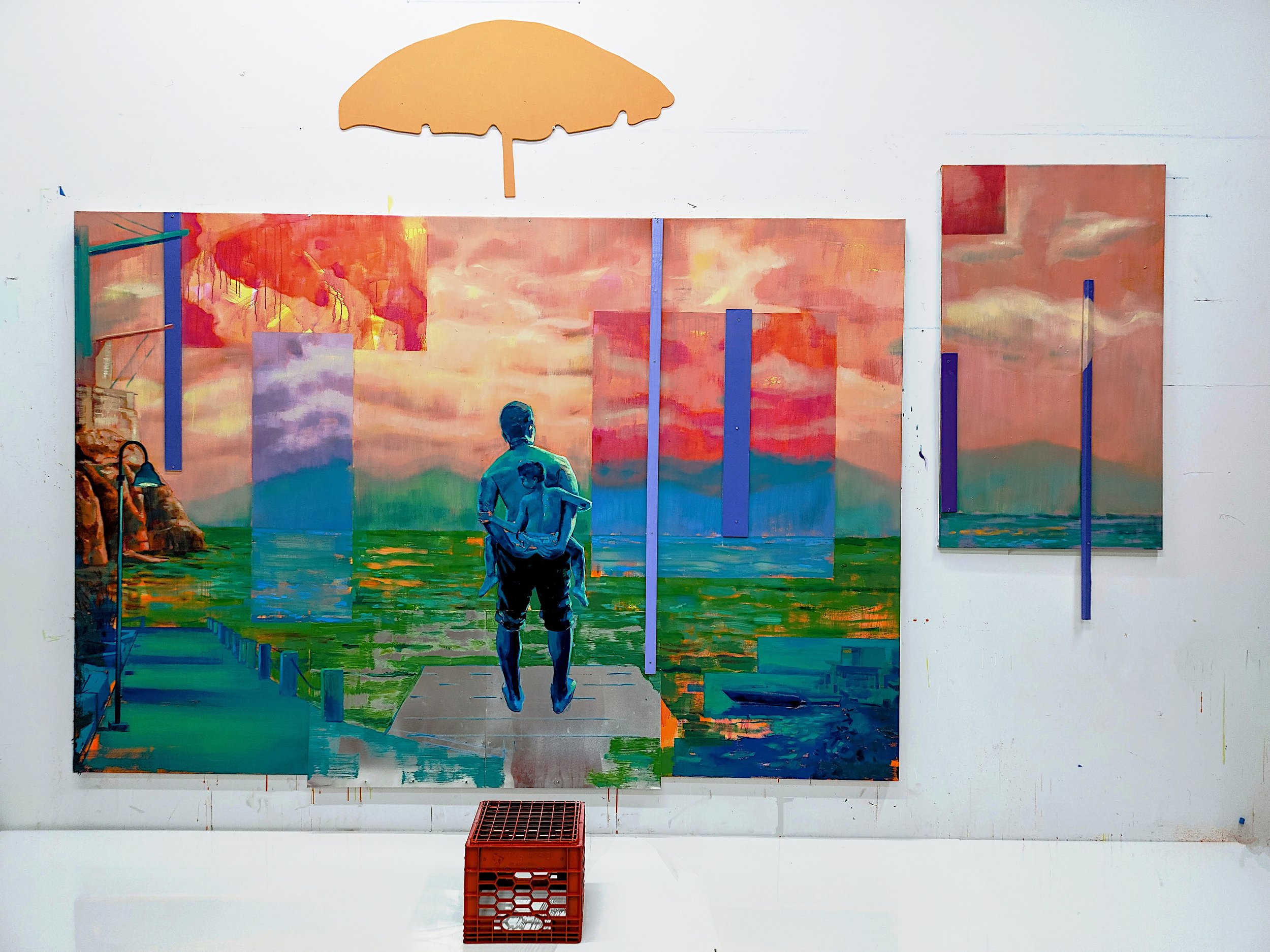
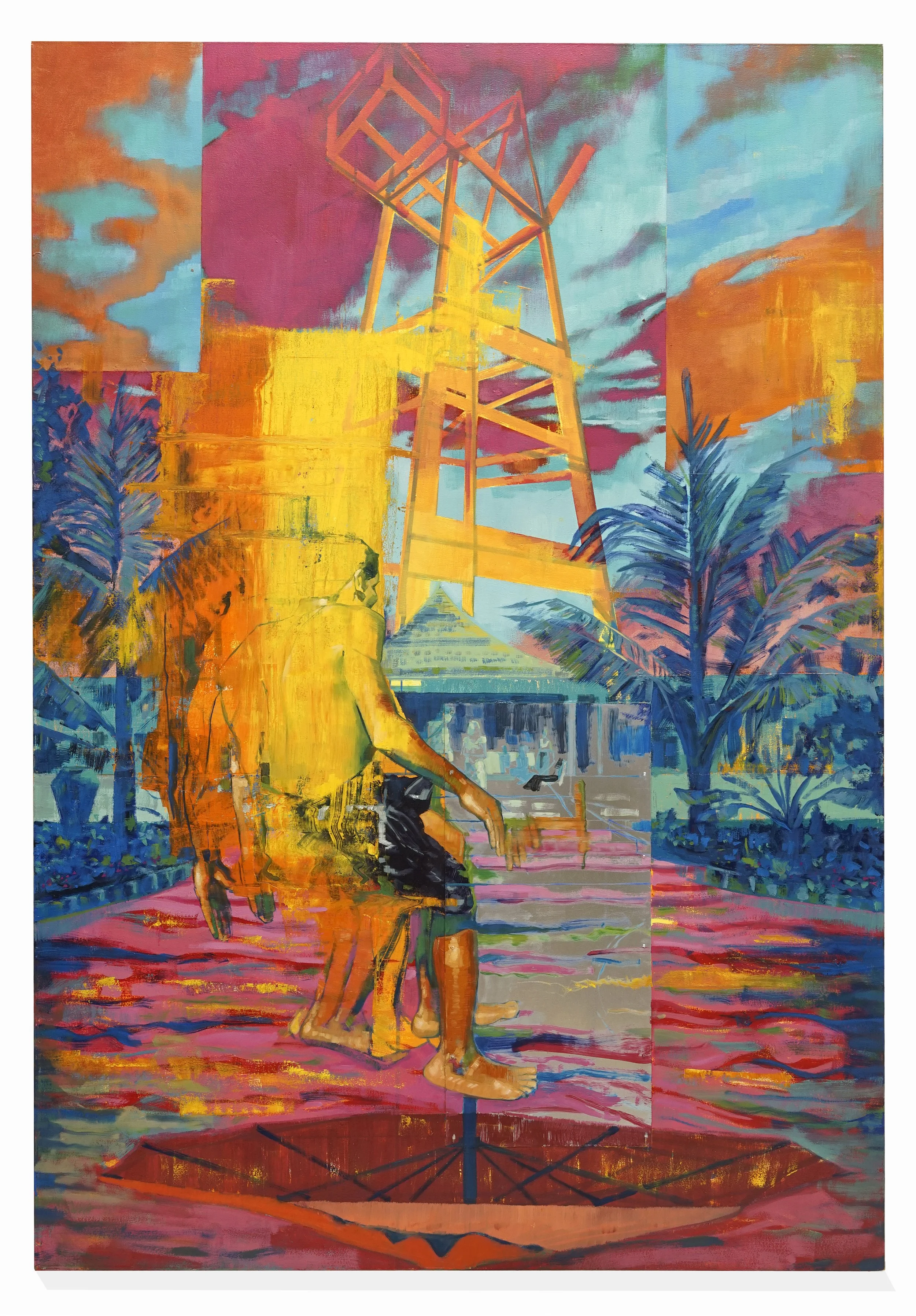
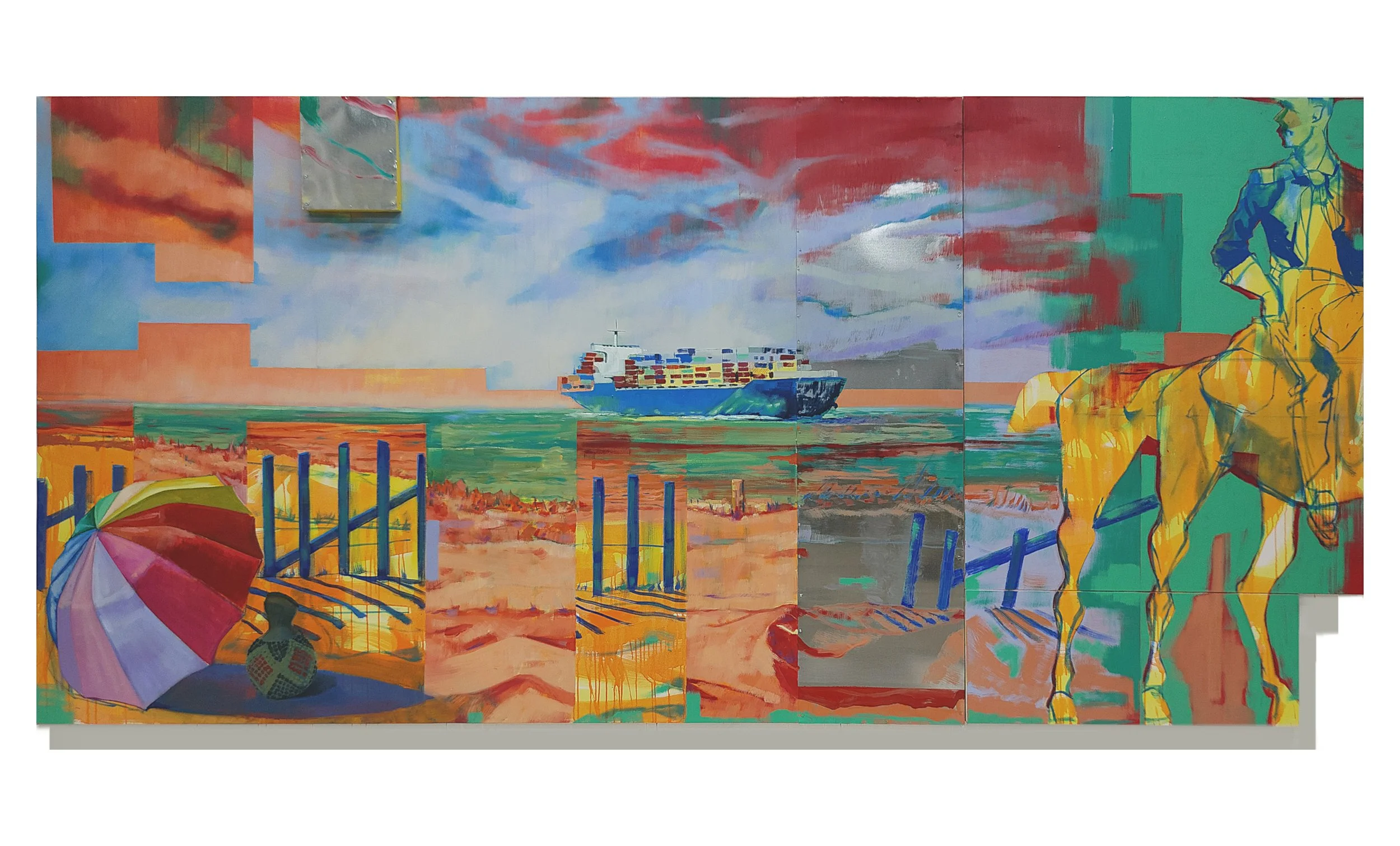
I want my work to function as a "legal receipt" for an experience real, documented proof that these internal, dissonant moments of being seen and seeing oneself actually occurred. This is evident in works like "PoolGirls and " She Carries the Horizon", where I investigate the disconnectedness of being a father and an a husband seeing the women in my life my never being fully able to really share in their life experience.
Your work examines Black manhood through fatherhood and sonhood. How do these roles shape your depiction of the Black male body?
The Architecture of Manhood: Fatherhood, Sonhood, and the Diver
My work serves as a deeply personal and systematic examination of Black manhood, filtered through the roles of being a father, son and husband. The arrival of my son, Judah, was another turning point in my life point in my life. It triggered a "life crisis" of identity the sudden, heavy realization that my life was no longer just mine to manage. This realization forced me to finally answer the "call" of the artist with total commitment.
My current body of work " Divers", is and answer to that call which turn out to be a continuous, cyclic dialogue between the history I inherited from my father and mother and the future I am currently projecting for my son. I am still haunted and motivated by a question my father asked me twenty years ago: "Andrae, what can you say you have achieved in your life?" That question lingers in the studio, driving the labor on the canvas.
When I depict the Black male body, I often use the image of the "Diver" as a primary armature. This image is a reference to the boys I used to see jumping into Kingston harbor, but it serves a much larger metaphorical purpose. It is a reimagining of the Icarus myth. While Icarus is often framed as a story of failure, I see the beauty in the human thrust toward the sun—the drive to become one's best self regardless of the fall. In my work, the water is not a place of drowning or a symbol of death; it is a cocoon that envelops and protects the figure.
I am also deeply concerned with the history of the African Diaspora. I often embed historical symbols directly into the work, such as the scheme of a slave ship, but I replace the bodies within those schemes with paisley patterns. This is a deliberate choice to show that an entire way of being, thinking, and dreaming was transported across the ocean alongside our physical bodies. I am constantly questioning: does a stereotype or an external "perception" lock me down, or can I be truly free? My art is the manifestation of that search for freedom.
How has social media impacted your work?
The Digital Bridge: Social Media and the Transcendent Purpose
Social media has become a vital digital bridge for my practice, a tool that effectively demystifies the "silence" that usually surrounds the artist’s studio. While social media is a powerful tool for the "business" of being an artist and a professor, I am careful to keep the practice itself rooted in the physical plasticity of the paint. It is about more than just an image; it is about sharing emotions and feelings. I want my work to spark a challenging introspection in the viewer, forcing them to ask: "Can you transcend your circumstances?" I believe that once you find that one specific purpose, that one fixed point of perspective, the entire world can open up to you filled with possibilities.
My work is the search for that point. It is a journey of becoming.