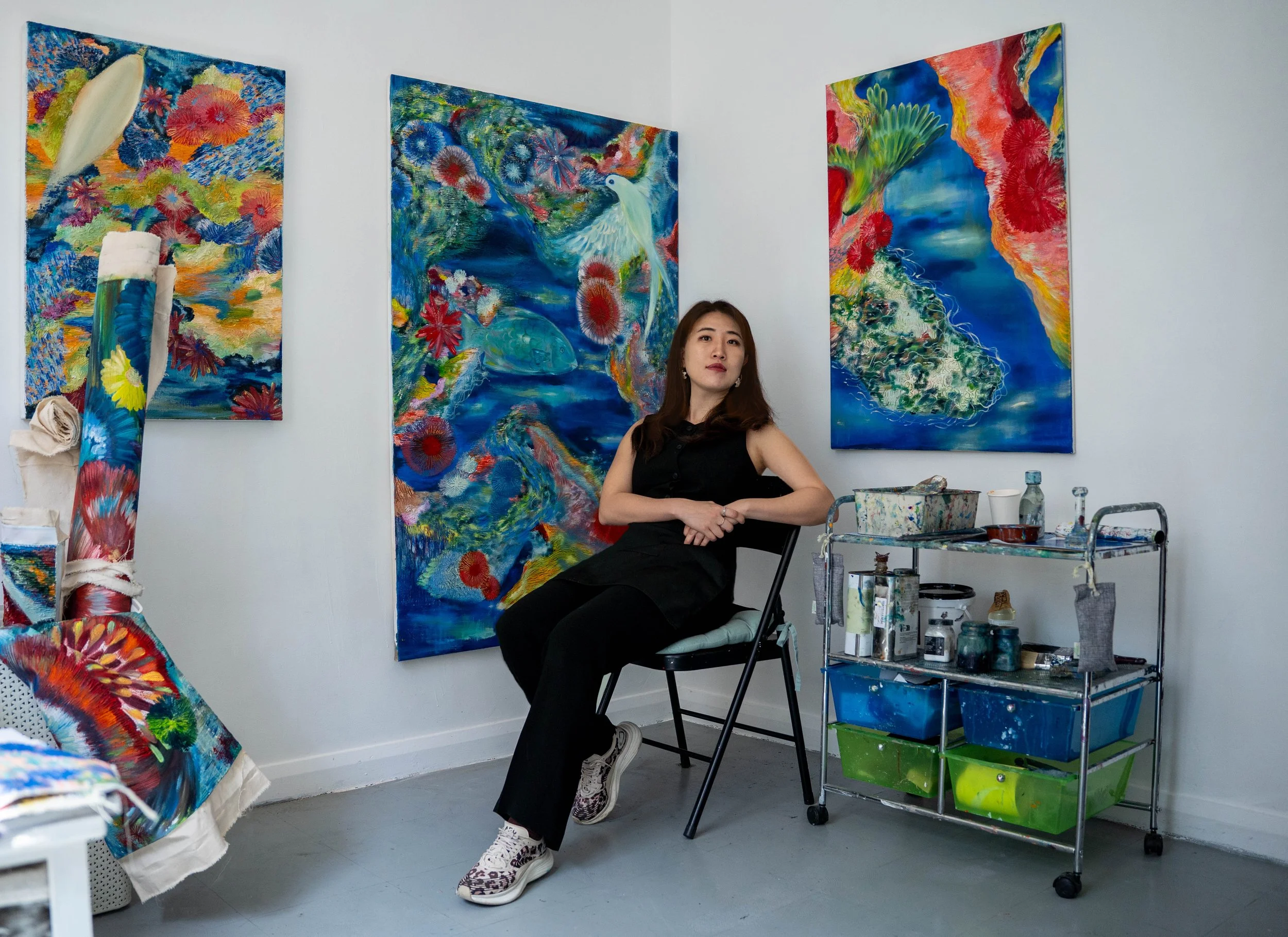
Yula Kim (She|Her) is a Korea-born artist living and working in London, United Kingdom. Her creative journey intertwines the rich tapestry of human cultures with the natural world. Through her art, she uses birds as poignant symbols, weaving narratives that reflect histories, identities, and the ever-evolving relationship between nature and society with her painting, as a main practice. Yula's artistic journey is a vibrant exploration of life's emotional and ecological traces, brought to life through her captivating use of color, a blend of figurative and abstract forms, and intricate spatial compositions. Rooted firmly in the tradition of painting, her work thoughtfully investigates the delicate balance between vitality and collapse, often drawing inspiration from themes of memory, migration, and the poignant realities of ecological loss.
How did your creative journey begin?
My creative journey originally began with music since my early childhood. I grew up playing the piano with a hope of becoming a pianist. But over time I realised that music alone could not fully express the visual worlds I was imagining. I became increasingly drawn to creating my own scenes as a way of translating how I see, feel and experience the world into something visible. Living across Asia, Polynesia, Africa and Europe has also deeply shaped this journey. Moving between very different cultures, landscapes and environments meant constantly encountering change and learning to see the world from different perspectives. At the same time, growing up within a strongly religious family sometimes made me question how I could form and express a visual philosophy that felt genuinely my own than merely following such traditions: how I understood myself, my surroundings, and what I wanted to communicate beyond the boundaries I had inherited. Some of those experiences were difficult and, at times, bittersweet. Ultimately, however, they became an important source of my creative practice. Art gave me a space where I could bring these different experiences together, question them and transform them into my own visual language. Nature gradually became central to that process. Wherever I lived, some form of nature was always present in my life, exotic birds, colourful fish, blue water, forests or open landscapes. I developed a deep appreciation for these subjects, not only for their beauty but also for the sense of certainty they gave me. Having encountered different cultural expectations, social pressures and questions of belonging from an early age, I needed a space where I could simply exist without constantly questioning how I might be perceived. Nature became that space. I did not have to perform or explain myself; I could simply be. This became particularly important after I moved to the UK to study art in 2016. Following my foundation studies, I made the interesting decision to take a gap year and went to Hawaiʻi in 2017. I had strong memories of Hawaiʻi from some parts of my earlier life, and found myself missing its blue ocean, birds, forests and extraordinary landscapes. I wanted to visually reconnect with those memories, but I also wanted to discover what returning there might offer me creatively. That period became an important form of artistic research. I encountered the volcanic landscape around Mauna Loa, the overwhelming Hawaiian volcano regions: KĪlauea | Halemaʻumaʻu, Hamakua Forest, with the massive red lava, the extraordinary blues of the Pacific Ocean, beautiful local birds and botanical creatures, and constantly changing lights from Kailua Bay. At that time, Hawaiʻi is often imagined from the outside simply as a beautiful Polynesian paradise, but my experience of it was more complicated. Its geographical and cultural isolation could sometimes make me feel intensely alone. Yet it was also a place where I became more conscious of how strongly nature, colour and sensory experience affected my understanding of myself and my surroundings. When I returned to London in 2018, those memories travelled with me. I gradually realised that memory itself could become creative material. Rather than merely reproducing landscapes exactly as I had seen them, I became interested in what remains after an experience: a particular colour, light, atmosphere, animal or emotional sensation, and how these fragments can later be reconstructed through art. This began to appear across different projects. In my moving-image | video work Window 2020, for example, I explored remembered windows and different qualities of light and life and it was presented in Auckland Art Week 2021. Then, birds also became increasingly significant, allowing me to move between personal memory and wider histories, symbolism and environmental narratives. This later informed projects including my work exploring birds and royal symbolism for the Platinum Jubilee Exhibition which was organised by Royal Borough of Kensington and Chelsea in 2022. Followed up, Mauna Kea became another particularly important memory. What stayed with me was not simply the mountain itself, but the experience of being there, the vast sky, the stars, the altitude and the almost brutal cold. I remember becoming overwhelmed and crying, but in a positive way. I felt intensely aware of being alive. I later carried that memory into the digital artwork I developed for the Charles III’s Coronation Concert in 2023. Experiences like this gradually shaped what I now describe as a “certainty of being”: moments when I feel completely present within the world and able to recognise myself beyond cultural or social boundaries. Nature does not necessarily provide an answer to questions of identity or belonging, but it gives me a space in which those questions can temporarily become quieter. Another significant turning point came during my artist-in-residency at Arts Letters & Numbers in upstate New York in 2023. Surrounded by forests, historic wooden houses, old industrial spaces and a supportive community of artists, I had the freedom to reconsider my practice. It was more than simply travelling somewhere new. Staying closely with nature and other creative people, in an environment where experimentation and conversation were encouraged, gave me confidence that I could take my practice much further. When I visited Hawaiʻi again in 2025, my relationship with landscape and colour developed further. I became particularly fascinated by what I describe as a sense of “glow.” Around Keauhou and Kealakekua Bay, I remember observing blue water and marine life appearing and disappearing through changing light. A young humpback whale, and later dolphins moving through the water, appeared almost luminous to me. That experience made me reconsider blue. It was no longer simply a colour representing the ocean; I began to associate it with light, elegance, movement, memory and the sensation of being alive. This sensitivity to glow and colour has since become another way of translating lived experience into my painting. Today, travelling and encountering the different part of nature remain important forms of artistic research for me. I collect memories, colours, sensations and encounters and later reconsider them in the studio alongside further visual and contextual research. I am not particularly interested in reproducing a landscape exactly as I saw it. Instead, I want to understand what the experience left within me and translate that into my own visual language between abstraction and figuration. Looking back, I think my creative journey has been shaped by this continual movement between places, memories and ways of seeing. Nature has remained one of the few constants throughout those changes. It continues to encourage me to create, while giving me a way to question and express what it means for me to feel present, to belong, and simply to be alive.
What significance do birds hold as symbols in your work?
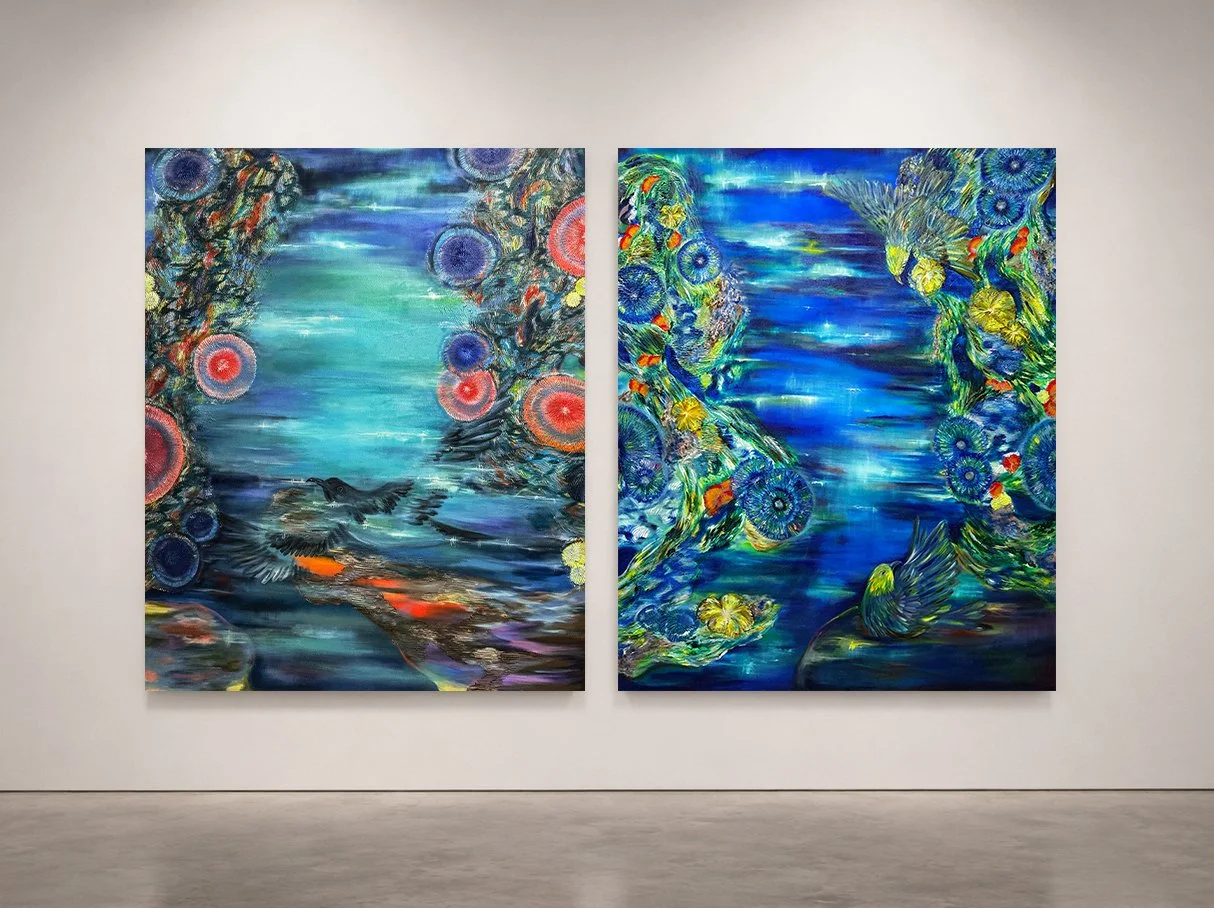
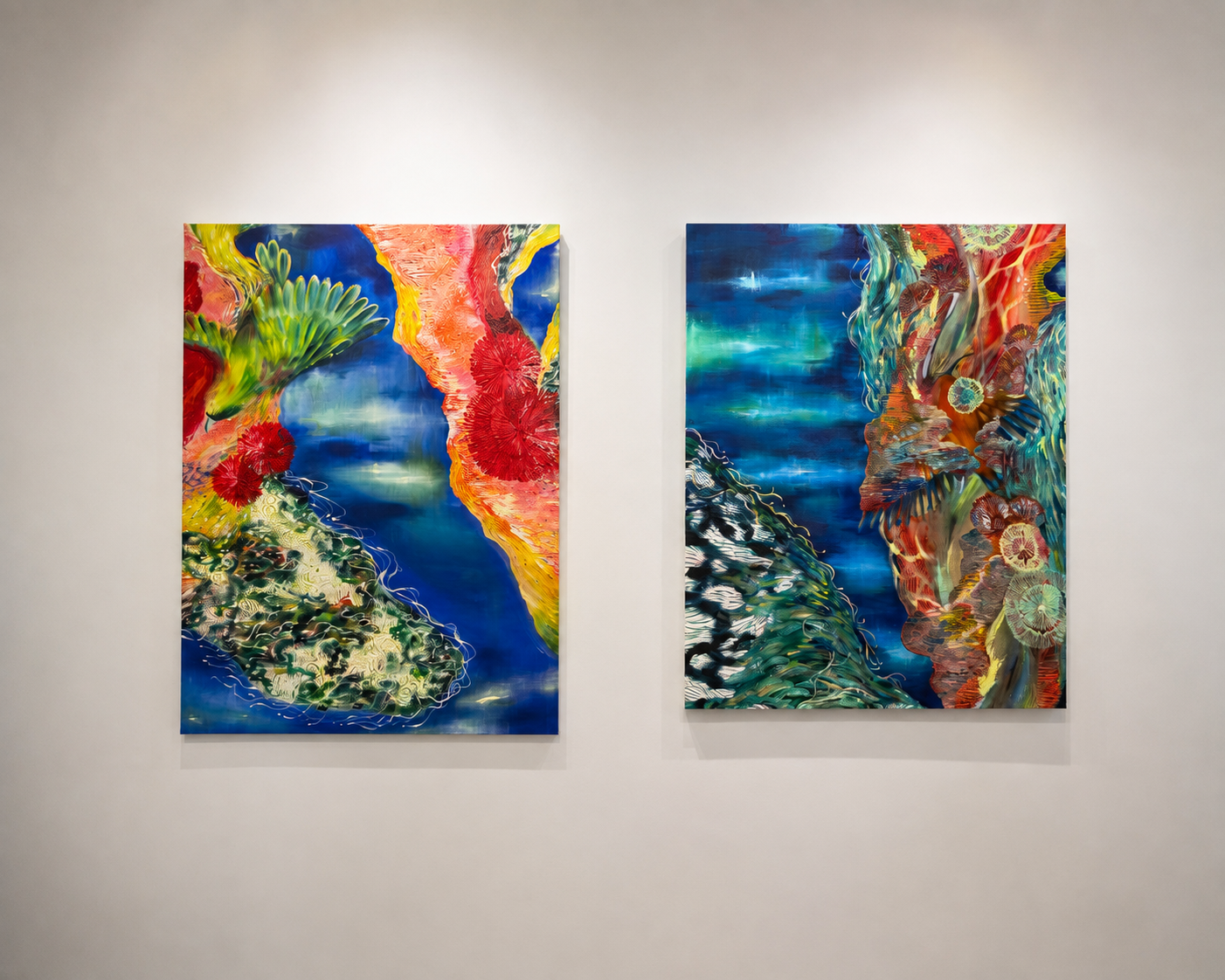
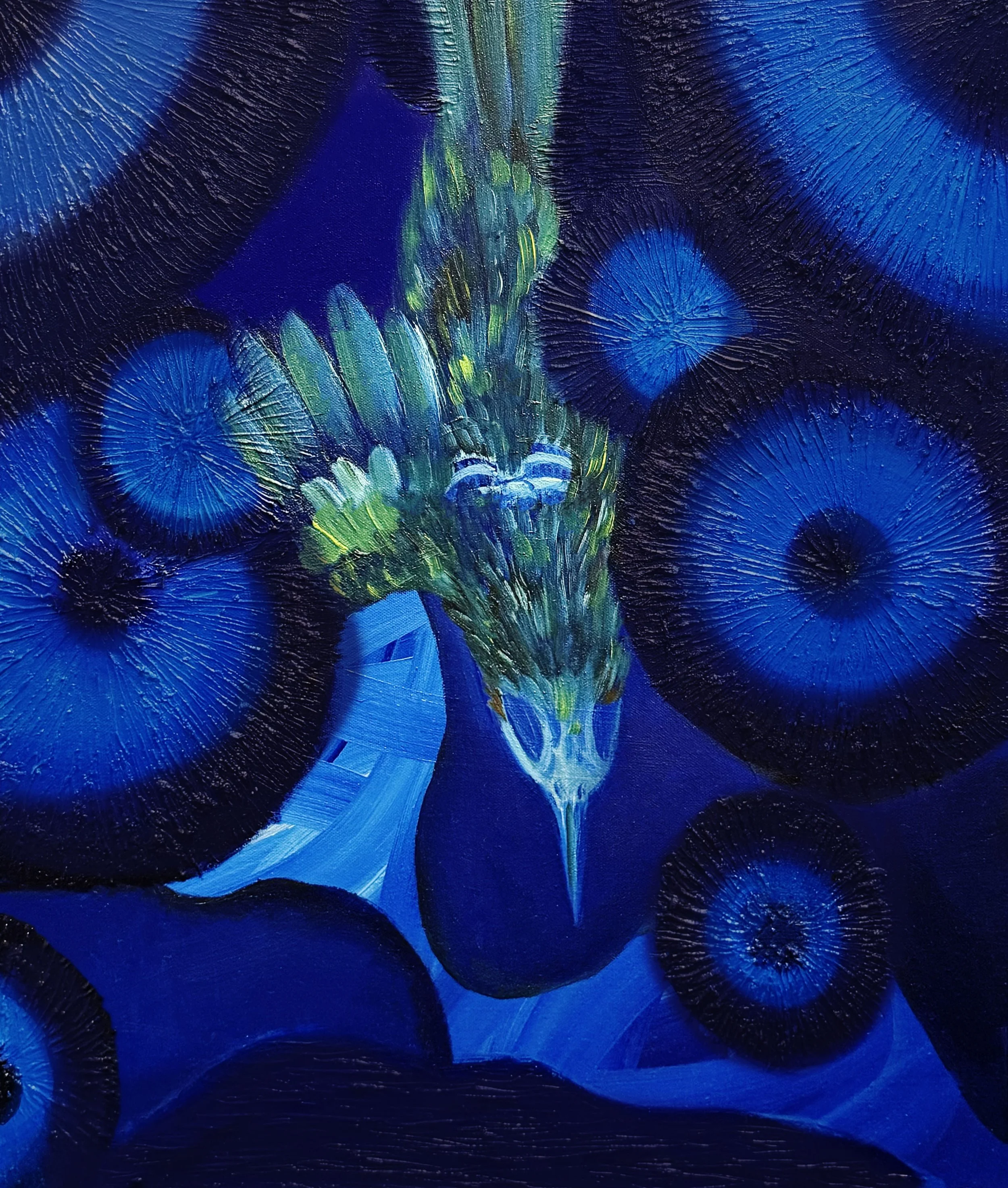
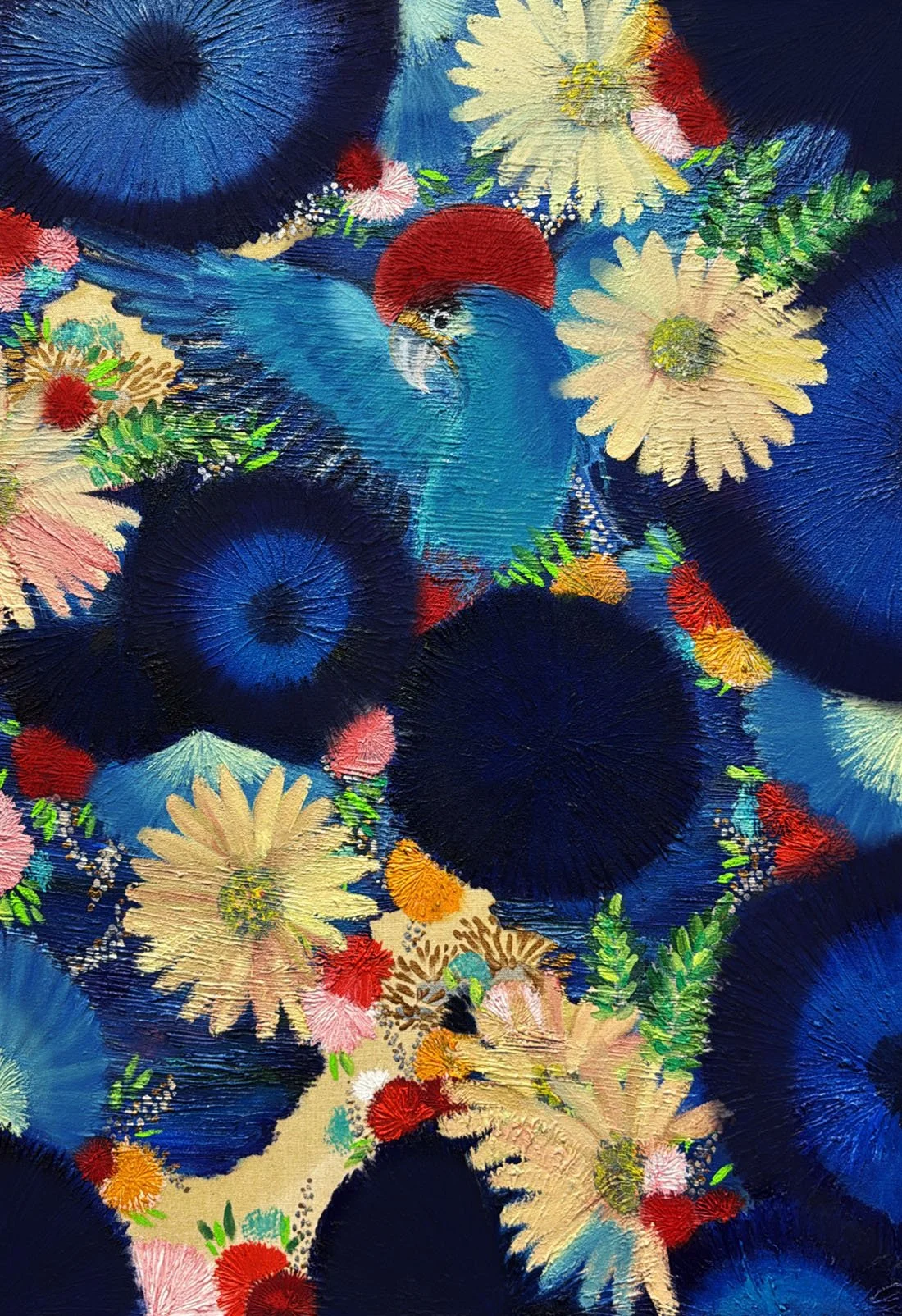
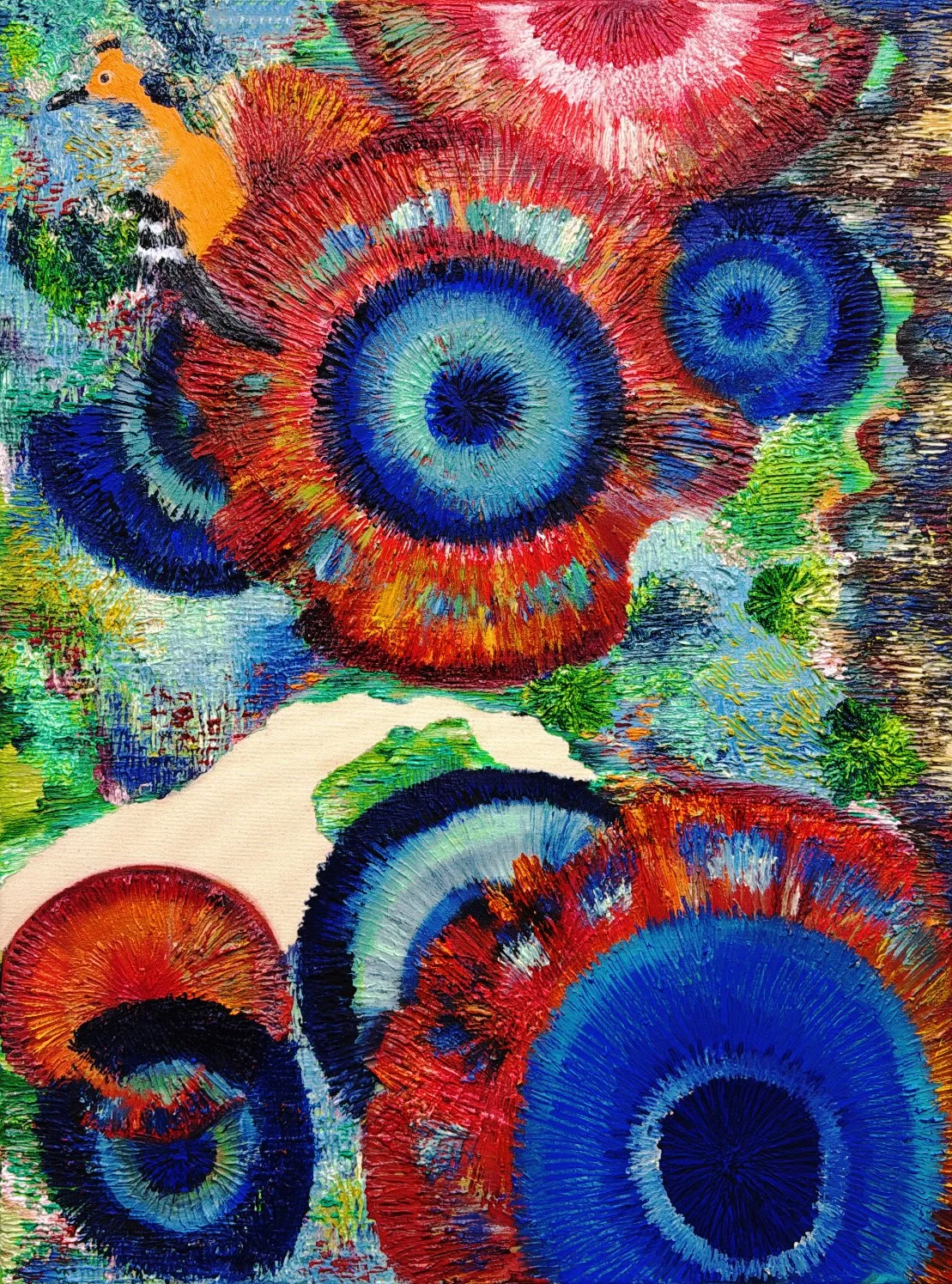
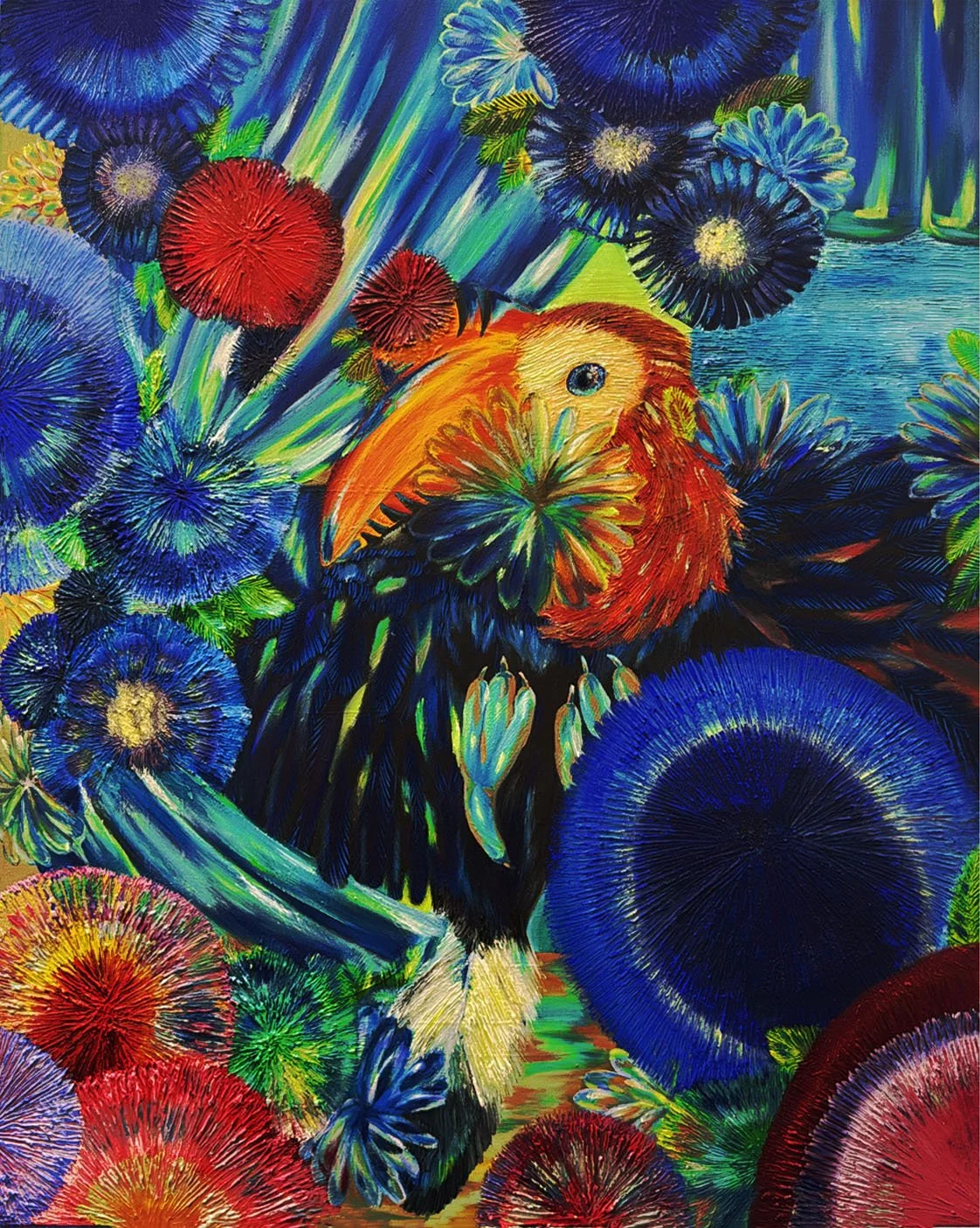
Birds have become recurring alter egos in my paintings. I am drawn to them not only because of how they look, but because of the lives they carry, their histories in endemic nature, habits, feather colours, and the very particular ways they move through the world. Sometimes I find myself becoming almost too attached to a species I am researching. I start with curiosity, and then suddenly I recognise something of myself in it. There is something about birds that feels both powerful and fragile to me. They can travel enormous distances and appear completely free, yet their lives are incredibly dependent on weather, habitat, season, and circumstance. I am fascinated by those small gestures: nesting on a branch, displaying color, making themselves visible to one another, leaving, returning, or simply pausing somewhere temporarily. Those moments can look confident and beautiful, but there is vulnerability underneath them too. That is why I never think of the bird as one fixed symbol. Each species carries a different temperament and multiple meanings for my artwork. One might hold freedom or curiosity; another might carry loneliness, uncertainty, stubbornness, disappointment, or a certain feeling I cannot quite explain in words. Sometimes they represent qualities I recognise in myself and sometimes qualities I wish I could keep. Eventually the bird stops being something I am simply painting and becomes a character through which I can look at myself from a slight distance. I am also very interested in the relationship between the bird and the landscape around it. I often return to this idea of “glow”, a surface-reflecting moment of the light on the object — which is the scene when something in nature feels incredibly beautiful and almost unreachable, yet somehow intimate at the same time. I can feel deeply connected to a place while also feeling slightly outside of it, as though I am belonging to it and observing it simultaneously. Birds naturally inhabit that space in my work. They move between memory, landscape and imagination, sometimes dissolving into their surroundings and sometimes standing apart from them. The brushstrokes follow that movement. I do not want the bird to feel cut out from the rest of the painting, so colour, texture and marks often travel across the whole surface. Forms can merge, disappear and re-emerge. For me, that instability is close to the way memory and relationships work with people, with places, and even with ourselves. Something can once feel overwhelming or certain and later become distant, romanticised, fragmented or unexpectedly vivid again. Underlying all of this is my interest in certainty. I do not think of certainty as having complete answers or knowing exactly where we belong. For me, it is much quieter than that. It is the small recognition that I am here, alive and present, even while everything around me is changing. Birds allow me to explore that because they embody both movement and presence. They can leave, return, adapt, build a temporary home and move again. Through them, I keep returning to the question of what belonging actually is. Is it something permanent? Is it something given to us? Or is it something we continually make and remake for ourselves? Ultimately, birds allow me to move between something deeply personal and something more universal. A painting might begin with my own memory, longing or uncertainty, but I hope the bird remains open enough for someone else to recognise part of themselves in it — their own freedom, vulnerability, displacement, desire, or simply the feeling of trying to remain present in a world that never really stops changing.
What does a typical day in the studio look like for you, and how has your art practice grown or changed?
A typical studio day usually begins before I reach the studio. I like to move first, going to the gym, running, or exercising outdoors because physical movement clears my head and gives me momentum. I think of myself as quite an energetic person, and that energy naturally follows me into the way I work. Once I arrive, I can disappear into research very easily. I genuinely love searching for things — a landscape, a historical reference, an unexpected detail, or a particular bird that suddenly catches my attention. I usually begin with small sketches and prototypes, almost testing the atmosphere of a painting before it fully exists. I like imagining how different elements might sit together, what might move, what might disappear, and what needs to remain. Birds are probably the subject I become most personally attached to. I love researching unusual species, particularly birds with distinctive histories, appearances, or ways of living. Sometimes I become almost too emotionally involved with them. A bird can begin as something I am simply curious about, and then suddenly I recognise something of myself in it, freedom, fragility, stubbornness, displacement, or even feelings that seem unnecessary or difficult to explain. At other times, they carry the parts of myself I actually want to hold onto. I think that is why they return so often in my paintings: they stop being simply birds and become characters through which I can quietly examine myself. Colour is another part of the process that I treat almost like a ritual. I keep a designer’s colour book and a colour wheel in the studio, and I love playing with different combinations before settling on a palette. I might place colours beside one another simply to see what kind of tension, softness, or glow appears. I am not only looking for what is beautiful; I am looking for the combination that makes the painting feel complete, as though all of its separate elements suddenly belong to the same world. That open stage is probably my favourite part. I can begin with a very clear idea and then discover that the painting wants to become something completely different. Sometimes, I can see one colour changes the entire atmosphere of my artwork that make more vibrating. Sometimes a bird I am researching unexpectedly brings back a memory of a landscape I lived with years ago. I like those moments because the work begins to feel less like something I am controlling and more like something I am discovering. On most working days, I spend at least six to eight hours in the studio. There is discipline in that, of course, because painting needs continuity, but I also stay because I genuinely love the work. Painting has become both my profession and part of the rhythm of my life. Even after a long day, I sometimes catch myself looking around the studio and thinking, “I actually get to do this.” There is a real sense of gratitude in that for me. I feel very thankful to God that I am able to build a life around something I care about so deeply. Over time, my painting practices and symbolic meanings have become much more instinctive and personal. Earlier, I was more concerned with constructing a scene or depicting a subject. Now I am much more interested in what remains emotionally after an image enters once’s, perhaps, my own past memory: movement, belonging, distance, uncertainty, beauty, and the strange feeling of being somewhere while also looking back at it.
I think the biggest change is that I trust those strange connections much more now. Research is still deeply important to me, but I do not want a painting simply to illustrate what I have discovered. I want research, memory, and lived experience to become something else entirely a world that feels familiar, but could only really exist inside the painting.
How has Vitalism shaped your artistic practice?
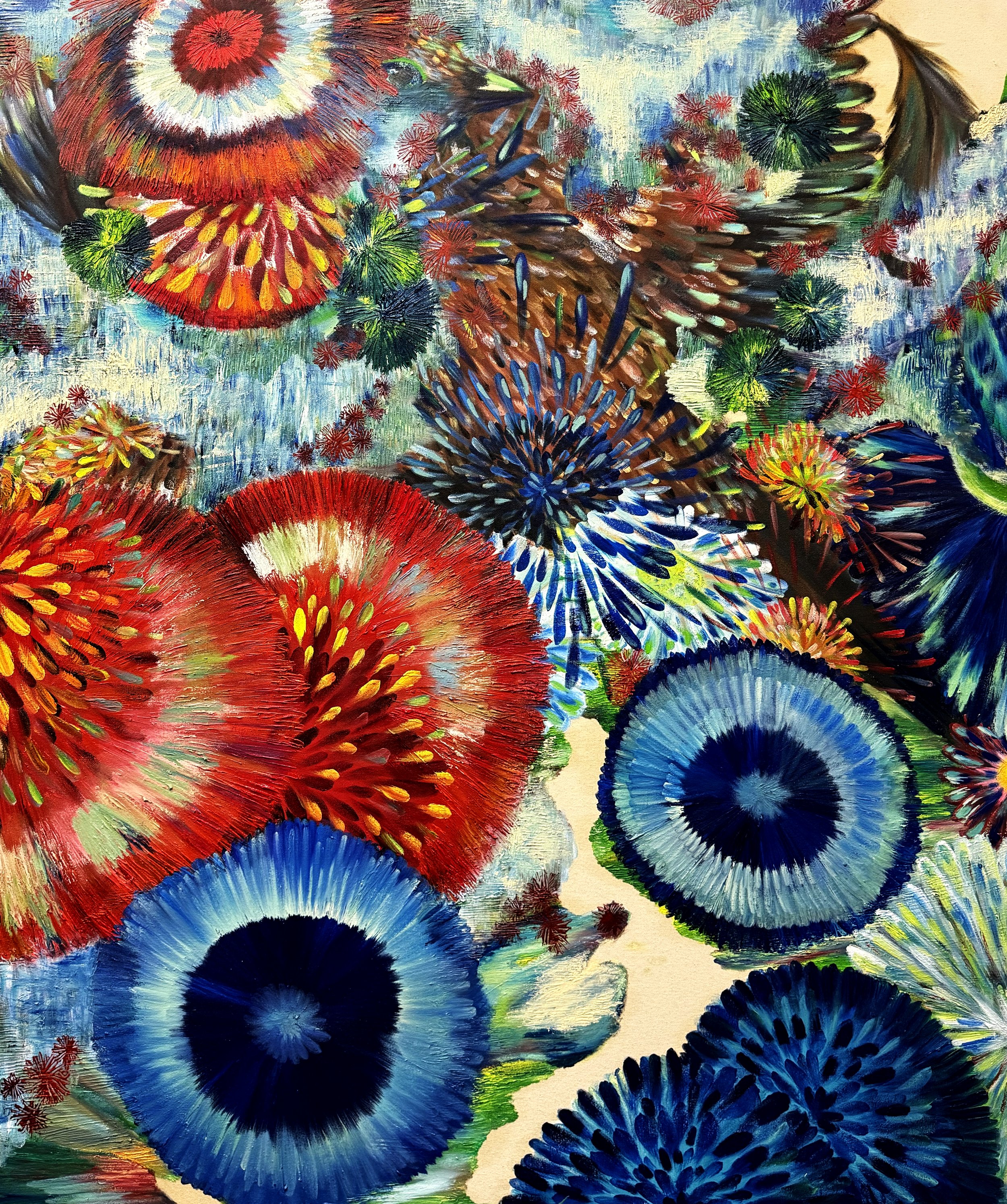
Vitalism has shaped my practice by making me think of painting as a way of holding onto the feeling of being alive in a space, no matter what changes around me. For me, that feeling appears when I become deeply connected to a place, an object, a memory, or a particular moment of beauty. It is less about Vitalism as an abstract philosophy and more about a personal sense of livingness — a moment when I feel integrated with what I am seeing, remembering, and experiencing in the present, despite changes in environment, place, or even living conditions. Memory is very important within that process. I often move between past and present while I work. A bird I am researching might unexpectedly remind me of a landscape I lived in years ago, or a particular colour, atmosphere, or natural form might bring back an emotion I thought had disappeared. One memory can lead to another, and one place can begin to overlap with somewhere completely different. I am interested in allowing those experiences to coexist rather than separating them into fixed moments of the past and present. This is also closely connected to my idea of certainty. For me, certainty is not only about having complete answers or knowing exactly where I belong; it is something much quieter — the recognition that I am here, alive and present. The beautiful parts of experience, but also the difficult, disappointing or sad parts, can all become part of that recognition. I do not necessarily want to judge those memories as positive or negative. Instead, I am interested in how they can come together and make me feel more integrated with myself, and perhaps closer to understanding who I am beyond external judgement or expectation. Very recently, this became a little clearer to me through an unexpected change in my personal life. Someone I had understood in a certain close way suddenly seemed different to me in many aspects, and it brought a mixture of disappointment, uncertainty, and a more critical reflection on how I had perceived that person. Yet it also reminded me that my sense of vitality does not disappear simply because circumstances change with someone. I can still recognise what I value, continue in my own direction, and remain attentive to how I see, feel, and experience the world. In a strange way, those unsettled moments can make the feeling of being alive even more visible to me. As a painter, those experiences inevitably enter the work, not as literal stories, but through shifts in colour, atmosphere, movement, and the emotional associations I attach to natural forms. I think that way of thinking has become especially important to me within contemporary life. We live in an incredibly fast-moving world surrounded by screens, information, constant stimulation and temporary forms of satisfaction. I do not feel that I necessarily need to attach myself to that speed in order to feel alive. Sometimes vitality can be found in something much quieter: noticing a bird, recognising a flower, remembering a landscape, looking at the movement of water, or suddenly becoming aware of a feeling that has been sitting somewhere inside you. That psychological relationship between nature, memory and the self has become an important part of my practice. The natural objects in my paintings can carry different fragments of experience — good memories, difficult ones, sadness, longing, beauty or uncertainty. Through painting, these different emotional states can exist beside one another and become part of the same visual world Vitalism also shapes the physical language of the paintings. Brushstrokes, combinations of colour and linear textures move across the surface, sometimes merging into one another, disappearing and then re-emerging elsewhere. Different visual influences and memories of places I have lived or travelled through can also meet within a single image. In that way, the painting can move from one memory into another, or from one atmosphere into another, almost like the movement of thought itself. Ultimately, these ideas become visible through the birds, flowers, water and other natural forms that recur throughout my work. I do not see them simply as decorative or symbolic elements. They become active carriers of memory, emotion, movement and presence. Through colour, brushwork, texture and the way these forms interact with one another, I try to activate the surface so that the painting feels less like a fixed image and more like something living — shifting, breathing and continually becoming. So although a painting might begin with the capture of a particular moment, I want it to hold movement, fragility, memory and presence at the same time. Wherever I am living, that process gives me a sense of continuity. It connects different stages of my life and reminds me why I continue to make art. In that sense, Vitalism has become not only a way of thinking about my paintings, but something very close to my own philosophy of living: even within uncertainty and constant change, there can still be a moment of recognition — I am here, I am alive, and this experience is part of who I am. By placing those experiences into the work, I am also opening them outward. I hope viewers can encounter the paintings through their own memories and associations, finding something within them that connects to their own sense of being alive.
How has social media impacted your work?
Social media, particularly Instagram, has had quite a significant impact on my work. One thing I genuinely appreciate is being able to see how other artists think, work and communicate their practices. I enjoy reading about the ideas behind their work, seeing how their practices develop, and discovering how curators and galleries approach art from their own perspectives. In that sense, Instagram has helped me understand the wider art world while also making me feel that I am part of a much larger creative community. It has also made connecting with people and presenting my own practice much more accessible. I can observe how other artists communicate their work, learn from their approaches, and think more carefully about how I present and promote my own practice. I find that exchange incredibly valuable. What interests me about social media is not necessarily the conventional idea of the influencer. I am less interested in being told which makeup to buy, which product is trending, or even which bottle of water apparently tastes better. What I really enjoy is seeing people working seriously on something they care about. I want to see artists talking about their practices, curators sharing how they think, galleries introducing their approaches, and people being open about the work happening behind what we eventually see. For me, that is one of the most exciting possibilities of Instagram. It gives us remarkably easy access to creative worlds that might otherwise have felt distant, and I really appreciate having that window into how other people think, and make artworks. Meanwhile, social media has also challenged me on a more personal level. I grew up around a religious culture where marrying young was often presented as part of an ideal faithful life for God. Hence, I often see friends around my age posting about marriage, with children and family life. I am genuinely happy to see them happy, but when you are repeatedly exposed to other people’s general life, it can be surprisingly easy to question your own life. Sometimes I have caught myself thinking, “I’m thirty, am I already late?” even though I know that I am happy developing my practice as an artist, and everyone’s life plan works different overall. Eventually, I realised that I do not want to measure my life that way because others are doing that. Getting married at twenty-five doesn't make someone more successful than others who doesn’t. A partner, a family with three babies, or a ring on the post should not become evidence that somebody is somehow ahead of everyone else in their friendship groups. Rather, it simply means that they are living a different life style. For me, the more serious question is why social media can sometimes turn deeply personal life choices into achievements that we feel we are supposed to compete over. That is why I have become much more selective about accounts to avoid unnecessary internal comparisons. I want to use social media in a way that contributes something to the arts rather than simply encouraging consumption or competition. Particularly as an artist, I am interested in how we can balance the personal and professional, sharing enough of ourselves to remain human while still focusing on our practices, ideas and genuine exchanges with artists, curators, galleries and audiences. I think learning to control what I consume, as well as what I choose to show, has become an important part of my relationship with social media and the way I present my work. I want to use it consciously curates my artistic space to contribute, connect and communicate my practices rather than allowing social media to tell me how my life or career should look.
Are there any particular artists or art movements that inspire you?
I have always been drawn to artists such as Marc Chagall, Claude Monet, Vincent van Gogh and Paul Gauguin, particularly because of the ways they move beyond straightforward representation. What interests me is how colour, memory and imagination can reshape what we see, allowing a landscape or natural form to become something emotional, symbolic and deeply personal. In Chagall’s work, I am especially drawn to the sense of memory and dream, and to the way figures, animals and places can exist together outside ordinary logic. That freedom has influenced the way I think about birds in my own paintings. They are not simply descriptive elements, but can become alter egos, presences or emotional carriers within the landscape. Monet has also influenced the way I think about light, atmosphere and the changing nature of perception. I am interested in how the same environment can feel completely different depending on light, movement, memory or emotional state. This relates closely to my own interest in water, glowing surfaces and shifting landscapes, where I am often trying to capture not only what a place looks like, but what it feels like to be present within it. I am similarly inspired by Van Gogh’s emotional use of colour and movement. His work reminds me that colour does not need to remain faithful to reality in order to communicate something truthful. I often use heightened colour, layered marks and gestural surfaces to express sensation, energy and the emotional intensity of being within nature. Gauguin is also important to me in the way he simplified and transformed landscape through colour and form. I am interested in that freedom to move away from literal observation and to create a visual world that is shaped more by feeling, memory and imagination. More broadly, I feel connected to aspects of Symbolism, Romanticism and Expressionism. Symbolism interests me because natural forms can carry meanings that are emotional rather than fixed. Romanticism connects to my fascination with nature as something beautiful, powerful, unfamiliar and sometimes overwhelming. Expressionism resonates with the way I use colour and gesture to communicate an inner response rather than simply describe an external scene. At the same time, my practice has been moving increasingly towards abstraction and semiabstraction. I still work with recognisable elements such as birds, flowers, water and landscape, but I allow them to dissolve into colour, texture, movement and atmosphere. I am interested in the space between figuration and abstraction, where an image can still suggest a place or memory without needing to fully describe it. Ultimately, these influences connect to my wider interest in presence and certainty-the feeling where I feel I alive from my living moments. I think of certainty not as something fixed or absolute, but as those brief moments when we become aware that we are truly here, present within a world that is constantly changing. Nature often gives me that feeling. Through painting, I try to translate those encounters into a visual language where memory, sensation and imagination can coexist, and where the natural world becomes something that is not only seen, but felt emotionally and intellectually.
What kind of emotional experience do you hope viewers carry with them after encountering your work?
I would never want to tell a viewer what they should feel in any fixed way. Instead, I want to create an atmosphere that feels beautiful, immersive, and perhaps slightly overwhelming, then allow each person to decide what that experience means to them through their own life, memories, and emotional associations. In that sense, I think of my work as emotionally flexible. The paintings are not intended to carry only one fixed emotional meaning. Their emotional life can shift depending on who is standing in front of them, what that person has lived through, and what they instinctively associate with the colours, birds, landscapes, or atmosphere they encounter. I really like the idea that the same painting might feel comforting to one person, melancholic to another, or bring back a completely unexpected memory for someone else. I hope there is a moment when someone is drawn into the color, the landscape, the bird, or simply the atmosphere of the painting, and begins to recognise something of their own emotional life within it. That connection does not have to resemble the feeling I had when I made the work. In fact, I find it much more interesting when a painting begins to belong to someone else in a completely different way. What I would love is for viewers to connect the work with their own experience of living — the places they have belonged to, the people they have known, the things they have lost, desired, remembered, or perhaps never fully understood about themselves. Sometimes an artwork can bring up a feeling before we even know how to name it, and I am very interested in that space. I also hope that this encounter can create a small moment of inward care or even the internal healing. We live in a contemporary world that moves incredibly quickly, where our emotions can easily become buried beneath constant change, information, movement, and expectation. If a painting allows someone to slow down for a moment, recognise what they are feeling, and give that feeling some space, then I think that can become a quiet form of self-care. There is often a tension in my paintings between something visually beautiful and something slightly distant or uncertain. I like that contradiction. I want the work to be seductive enough to draw someone closer, but open enough that, once they are there, they can begin to encounter their own memories and emotions rather than simply mine. Ultimately, I hope the paintings can act almost like emotional spaces rather than fixed statements. If someone leaves carrying a feeling that is difficult to explain, but somehow feels more connected to themselves and to their own experience of being alive within a rapidly changing world, then I think the work has done something meaningful.